

We just returned from a road trip to Montreal, where we made some new (animal) friends and caught up with some old (human) friends.

Being on vacation is a good opportunity to try a new email format: A digest of some ideas, stories, and data points that caught my eye this week. Before you read, make sure you’re up to speed on the latest buzzwords and terminology by reading my recent piece on The 50 Words That Explain AI.
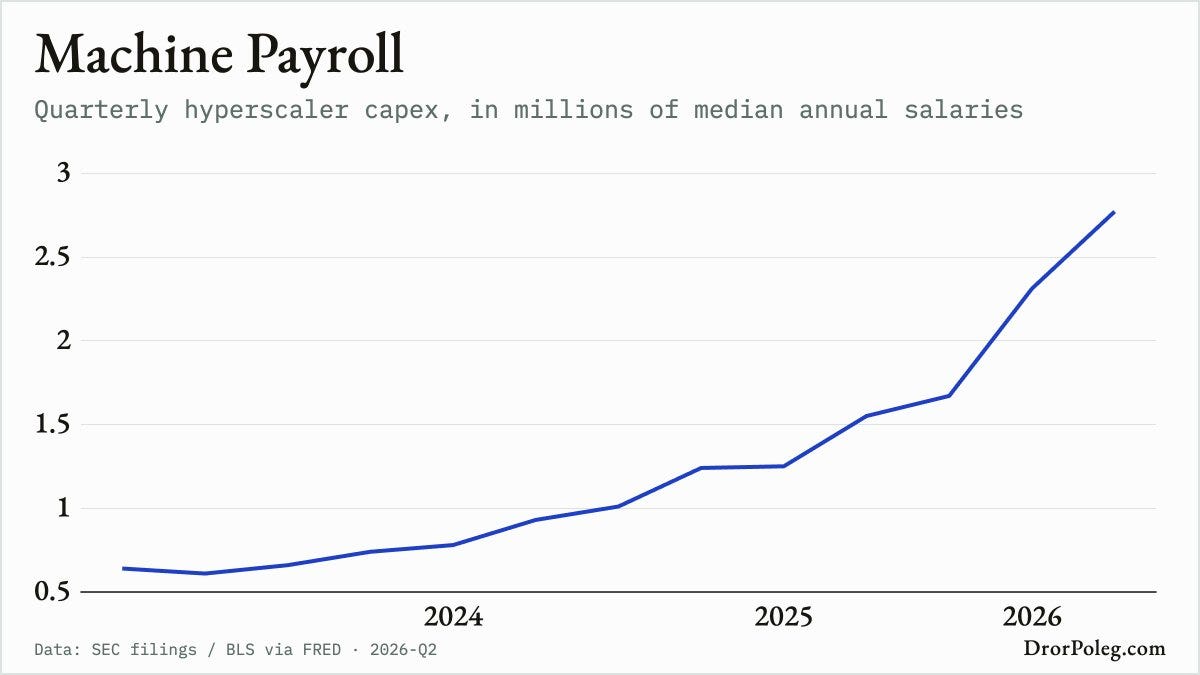
Big tech’s quarterly spending on AI infrastructure is now equivalent to nearly 3 million median annual US salaries. Much of the slowdown in tech hiring is not due to AI directly replacing people, but to companies freeing up money to invest in AI infrastructure.
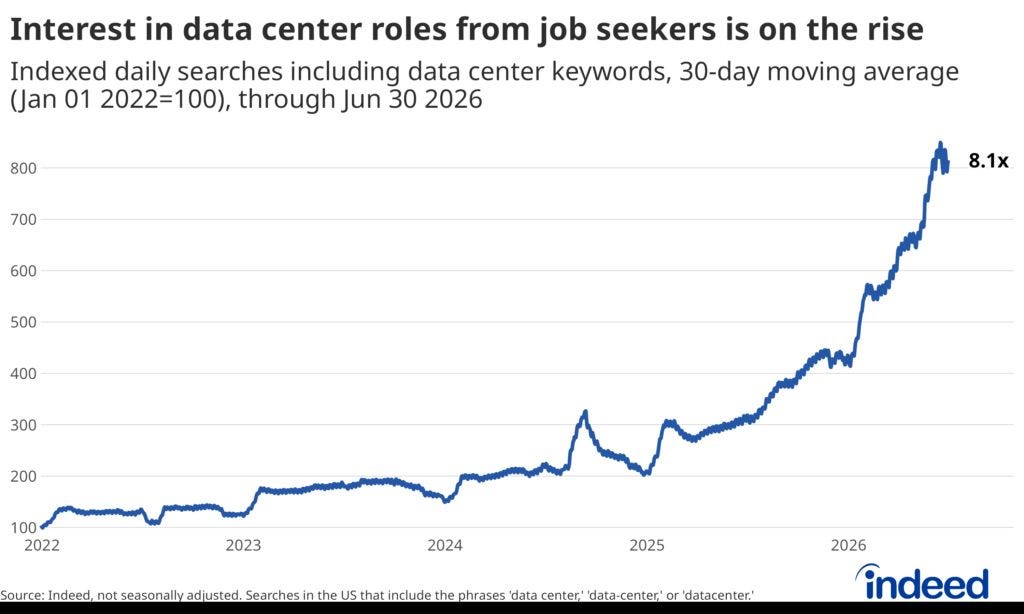
Interest in data center jobs on Indeed has increased more than 8x since 2022. Big Tech’s spending is creating a lot of jobs, for now. But these jobs are for builders, electricians, and technicians. The AI boom’s most tangible labor-market effect so far is in the construction and maintenance of physical structures.
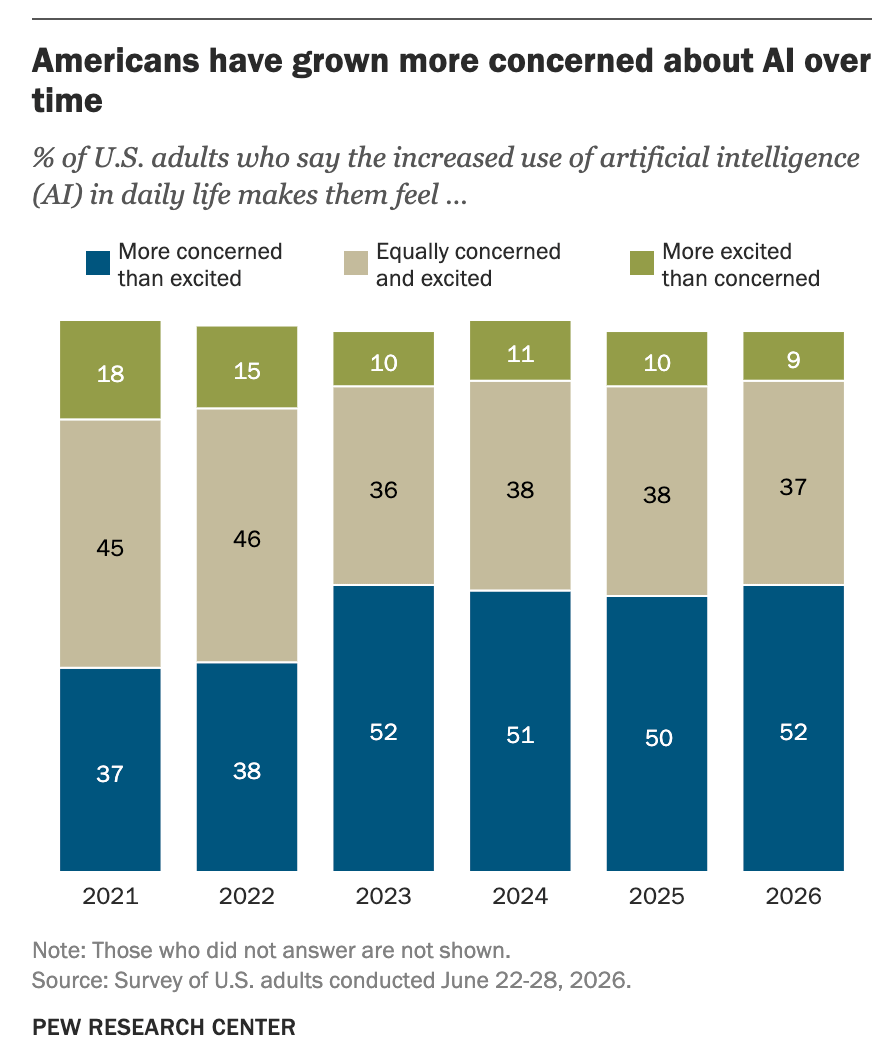
Americans are less excited about data centers. They may create jobs, but they also create significant political discord. The latest data from Pew Research shows that, for the first time, a majority of Americans under 30 are more worried than excited about AI. In total, 52% of Americans now say they are more concerned than excited, up from 37% in 2021.
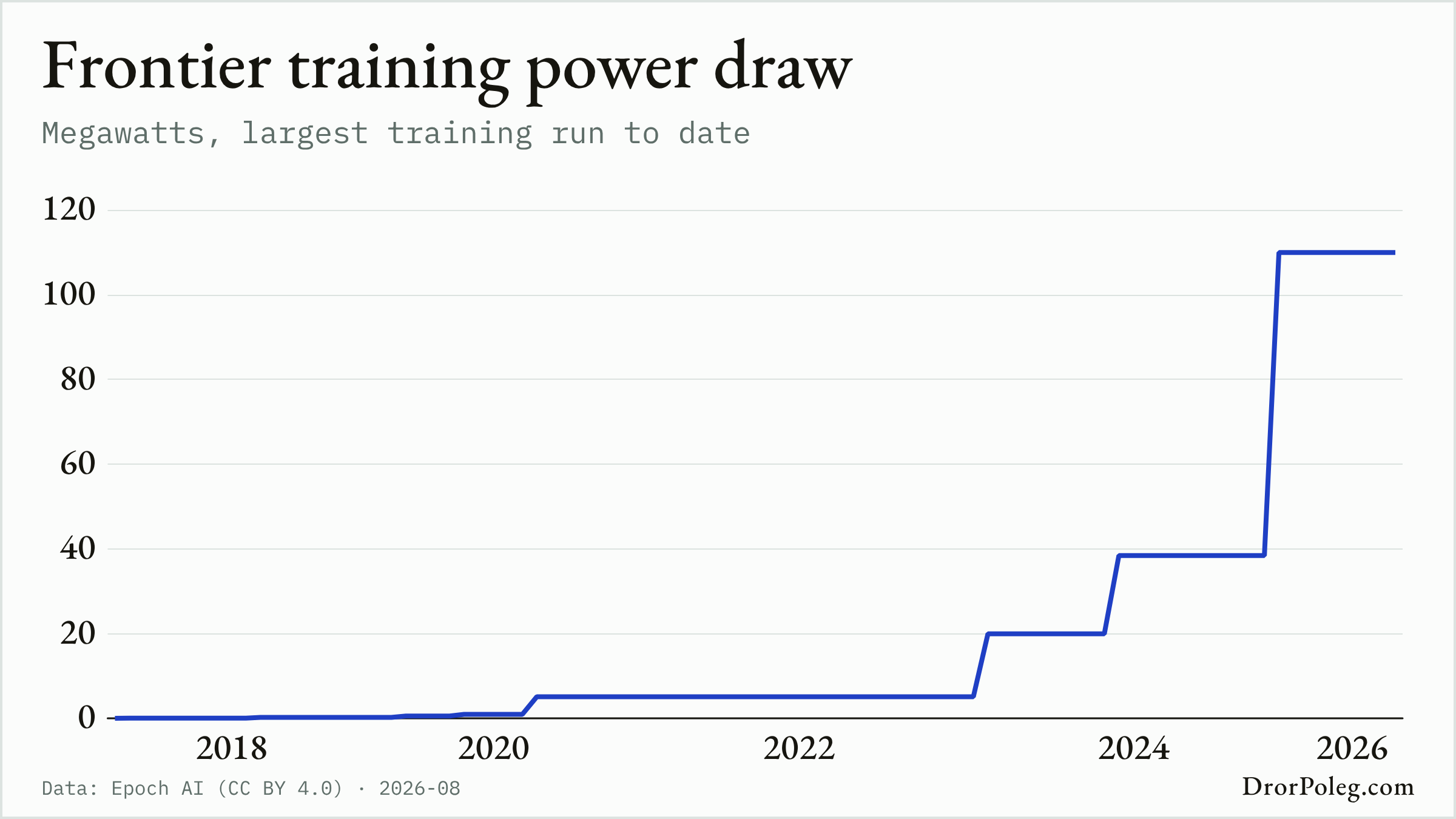
Power is at the core of the AI backlash. Specifically, electricity. Unlike traditional software data centers, the buildings used to train and serve the latest AI models consume much more electricity. And their appetite is only growing: Training a frontier model in 2026 requires 20x the power it did in 2020. (Not sure what a “frontier model” is? Read The 50 Words That Explain AI)
AI is also affecting software jobs, but more modestly. Recent data and analysis from the Federal Reserve of St. Louis shows that “software coder” employment has decelerated sharply since November 2022, and that this deceleration points to an AI shock rather than a general slowdown.
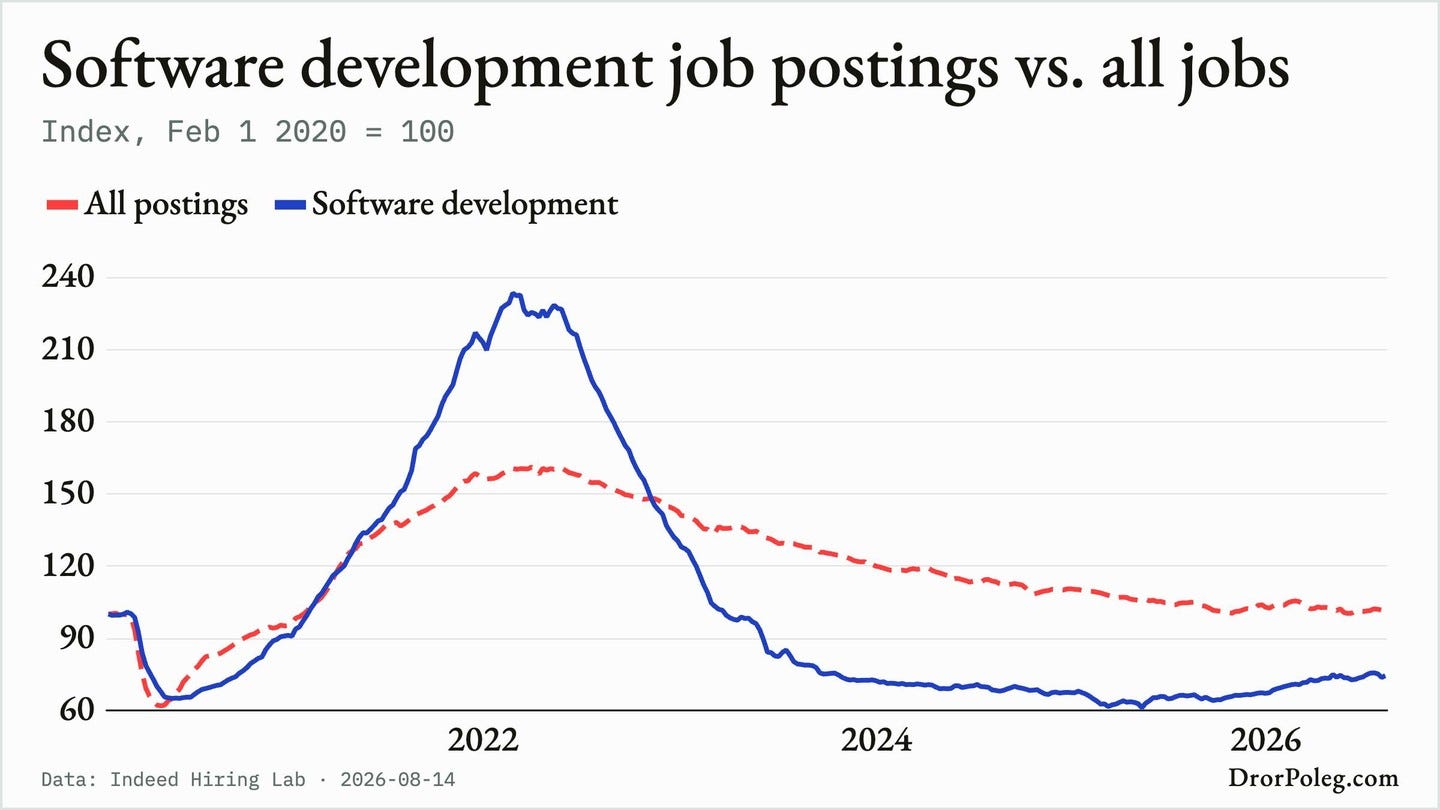
This is also a good time to remind everyone: Yes, software job listings have recovered (slightly) from their post-COVID lows. However, they remain (significantly) below the pre-COVID level.
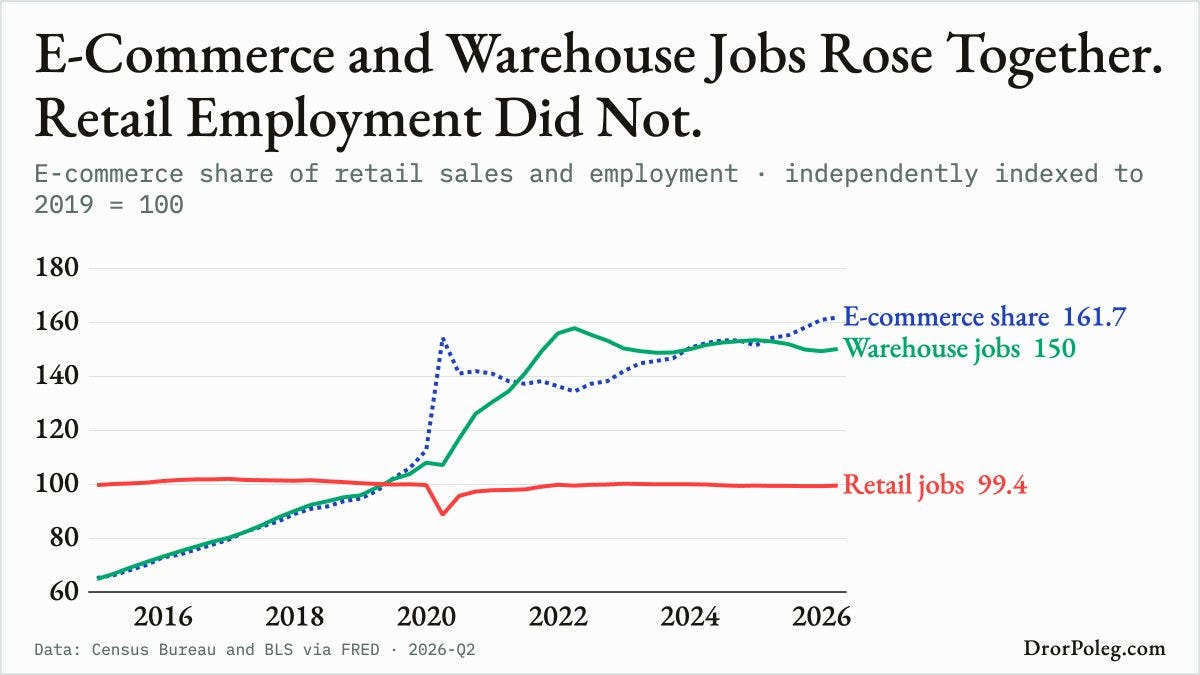
Retail employment offers an important perspective on how technological disruption affects jobs. When people imagine AI destroying jobs, they picture collapse. History suggests something quieter: stagnation. The e-commerce boom did not destroy retail jobs; it left them behind while everything else grew. Expect the same pattern with AI: affected occupations don’t vanish; they flatline while the economy moves on without them.
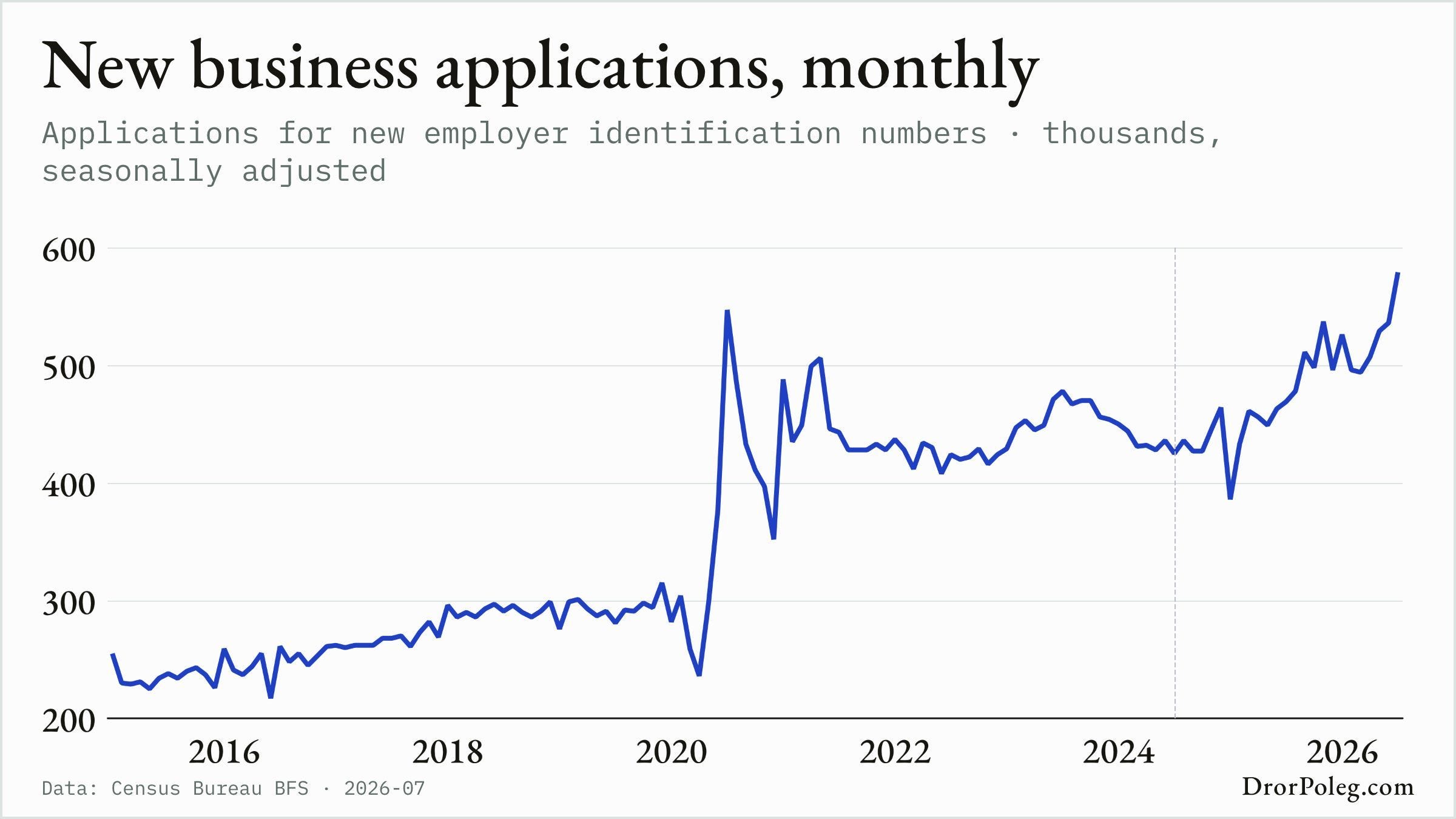
One possible sign of a changing labor market: new business applications in the US just exceeded their Covid-era high. The pandemic surge in new firms was supposed to be a one-off effect of massive layoffs and people YOLOing and “quiet quitting” to pursue their side hustles. That surge has now been exceeded. Whatever else AI is doing to employment, it isn’t stopping people from starting companies (it’s probably encouraging them to). Not every business registration becomes an actual business, but the trend is worth keeping an eye on. Is this a sign of dynamism or distress? Probably a bit of both.
AI can recognize other AI, and it can recognize you. A new initiative by Anthropic and other AI companies to add a “watermark” to help identify AI-generated text highlights the unique way LLMs “see” language. As I wrote in my most recent piece:
AI-generated text has unique statistical patterns that distinguish it from human-generated text. And specific AI models have specific patterns that distinguish them from other models.
The same is true for humans as well. The way each of us talks has unique statistical patterns: The frequency of certain words, the length of the pauses between sentences, and the average length of all words and sentences — all add up to a signal that distinguishes you from anyone else. And it also distinguishes humans in general from machines.
You can read the full piece here.
That’s it for this week. For lots more data and charts about AI, jobs, energy, construction, and consumer sentiments, check out my dashboard. If you enjoyed this email, do forward it to a friend!
Have a great weekend.
Dror
How will AI affect your company, industry, and career?
My speaking schedule for the fall and winter is filling up. Visit my speaker profile and get in touch to learn more.

Click here to book a keynote or learn more.
AI-related data center is frequently falsely framed by media. Water is and has always been a local issue. But setting that aside, the long-term problems in aggregate are huge. The planned 2026 buildout of data centers is, in terms of metric tons of carbon dioxide added to the atmosphere, equivalent to putting 50% more vehicles on the road. There will be an exponential increase in the number of methane leaks associated with buildout of new natural gas infrastructure. Methane is, far and away, the worst heat-trapping greenhouse gas — trapping +40% more heat. Then there is the issue of toxic runoff from construction sites into local watersheds (e.g. heavy metals). Then there is the issue of negative health effects from low-grade noise emitted by data centers.
We can’t burn up the planet fast enough? This is not Nimbyism”; it’s a suite of serious long-term environmental damage.
Finally, concrete is at the top of the list for contributing to climate change. At-the-edge fractal-computing will serve most of AI use. The hardware costs are multiples lower, +100% more compute can be achieved for the same unit of energy, and diffusion/distribution of fractal-computing hardware provides more data security. Big data centers are future soft targets for terrorism.
AI is eating itself. Cheaper, good-enough AI will likely commoditize most of the market. There isn’t enough enterprise use for the expensive models (Anthropic, OpenAI, et alia). So, why the inefficient and expensive push of LLMs on old technology? It’s likely an attempt by the big hyperscalers to continue to control the compute market. Cripes, it may reach a point where cheaper, good-enough Chinese AI models may be used in the U.S. to defend data against hacks by the big hyperscalers.
AI talent is diffused and can be scaled for most uses by smaller, independent providers. Bespoke AI can be brought in-house.
Love this format. Interesting and digestable, and something I don’t think I get elsewhere. Thank you!