


Everything around us is changing quickly, and language is no exception. You may have heard someone speaking about their personal p(doom), or read a report questioning whether DeepSeek distilled ChatGPT, or whether China’s new Kimi K3 model is genuinely smart or merely benchmaxxed. Meanwhile, you might be worried about AI alignment and the risk of zero-day exploits from models that can one-shot a devastating cyber attack.
There are dozens of new words like that. They are popping up in media reports and social media feeds and dinner conversations. These words are important. It is important to understand them. They contain insights about how artificial intelligence works, what it costs, who controls it, how quickly it evolves, and what it means for our jobs and society.
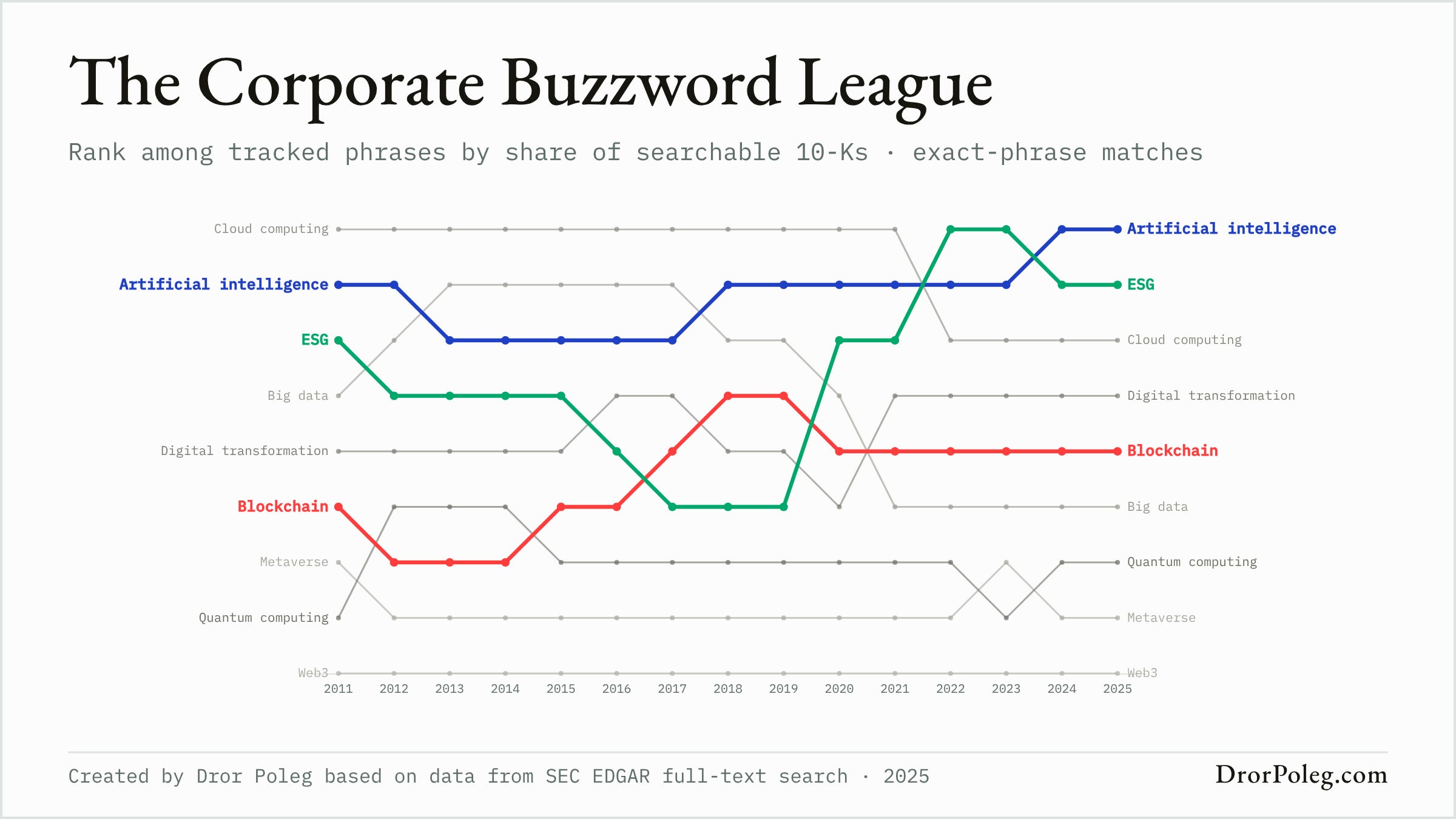
Corporate America is already obsessed with AI. “Artificial intelligence” is now the number one buzzword in the country’s annual reports, appearing in nearly one in ten searchable annual reports. AI has unseated ESG and is far ahead of blockchain and the metaverse, both of which topped this league in their day.
This special piece explains and contextualizes around 50 of the most important words in the AI discourse. I wrote this piece together with Claude Fable 5 and GPT-5.6 Sol. It includes custom illustrations and charts from my data dashboard. If you spend 20 minutes reading it, you will know more than 99% of the people on earth about this topic.
Let’s begin.
(If you want to go beyond 99% and see how AI affects your specific industry, company, or investment strategy — you can always book a keynote or consultation)
The Hardware
Start with the machinery, because everything else in the dictionary descends from it.
A CPU, or central processing unit, is the chip that has run computers since the 1970s. It has a small number of cores that perform difficult calculations one after another. A CPU is like a small number of brilliant clerks working one instruction at a time, very fast, in sequence. For decades, the CPU was synonymous with “computer”; it handled the simple process of converting input into output, reliably. It followed logical instructions, predictably.
In contrast, a GPU, or graphics processing unit, has a massive number of cores that perform simple calculations in parallel. It is like a crowd, or a stadium full of low-level clerks. GPUs were invented to paint video-game pixels, millions of which need the same simple math done simultaneously.
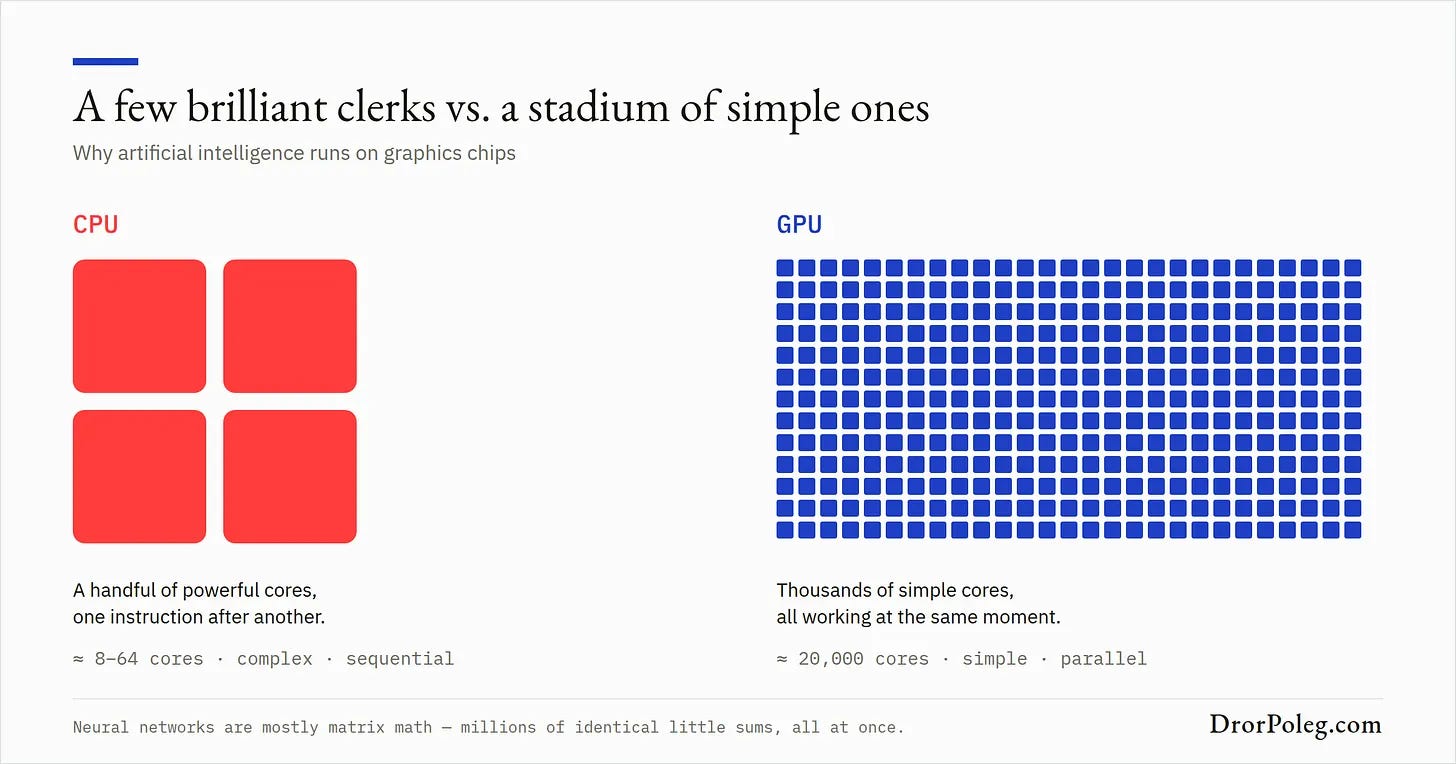
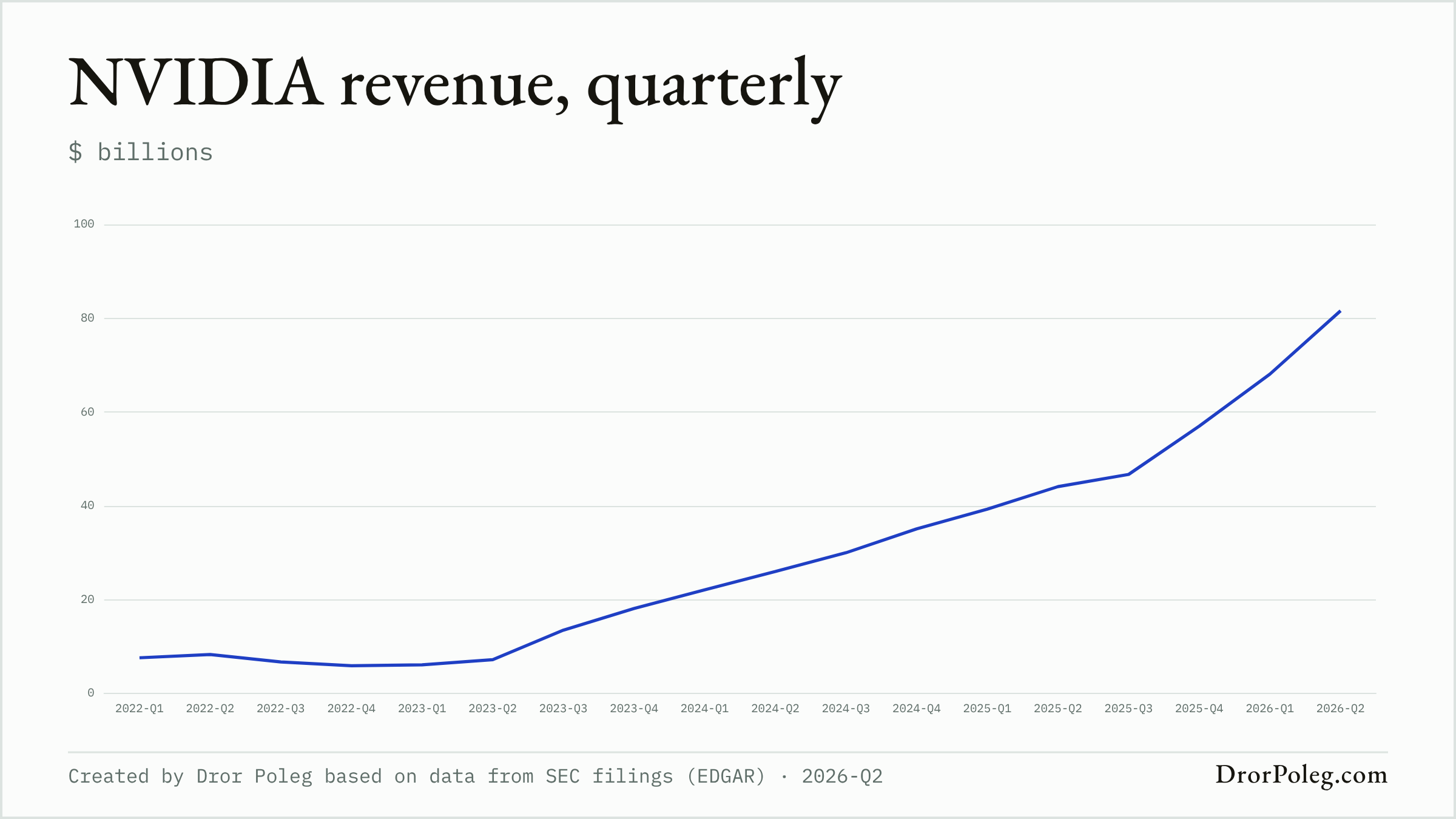
Then came the discovery that reshaped the world economy: the neural networks that power the most popular AI models work better on GPUs than CPUs. Their mathematical structures require the parallel multiplication of enormous grids of numbers. It turned out that painting pixels and “thinking” have more in common than traditional machine logic. That’s how Nvidia, a company that originally created video-game hardware, became the poster child of the AI boom and, for a while, the most valuable company on earth.
The unit of account for all the work done inside GPUs and CPUs is the FLOP, or floating-point operation. A FLOP is a little act of arithmetic. When you read that a model was trained with 10²⁶ FLOP, that is the number of additions and multiplications performed: a hundred septillion.
The third word in the hardware trinity is the least unique and increasingly the most important: memory. A GPU can only compute as fast as numbers can be fed into it. The feeding — not the thinking — is the bottleneck. Engineers call this the memory wall. The workaround is HBM, or high-bandwidth memory. It’s a type of memory chip (or chips) that are stacked in a way that shortens the distance and time it takes information to flow into and out of the processor. HBM is why South Korea, home of SK Hynix and Samsung, holds a seat at the geopolitical table: the smartest chip in the world is only as smart as its memory lets it be. Chips are rarely too slow; they are usually too hungry. Better high-bandwidth memory chips enable GPU processing chips to “eat” faster.
Learning and Doing
Now the pair of words that explains the economics of the entire AI industry: training and inference.
Training a new AI model is like sending it to school. For months, tens of thousands of GPUs read a filtered copy of the internet and play a trillion-round guessing game: predict the next word, check the answer, adjust. The adjustments accumulate in the model’s weights (also called parameters). The weights are made of billions of numbers that encode everything the model “knows,” the little patterns and tweaks it noticed while reading and re-reading human text (or looking at photos or videos). The longest and costliest “semester” of this schooling period is called pretraining. This is when most FLOPs are consumed. But school does not end there. Once pretraining is done, AI models are fine-tuned. They receive feedback about their answers and behavior and are tweaked to work better or to be easier to interact with (more on this in a moment). This is sometimes called post-training.
Once training is complete, a new model like GPT-5.6 or Claude Opus 5 is ready to start working. This work is called inference, the process of using the model to generate content in response to a user request. Every time you ask a chatbot a question, the finished model runs your words through those frozen weights and produces an answer, token by token. (A token is the syllable-sized chunk of text models actually read and write — the atom of AI economics, priced by the million.)
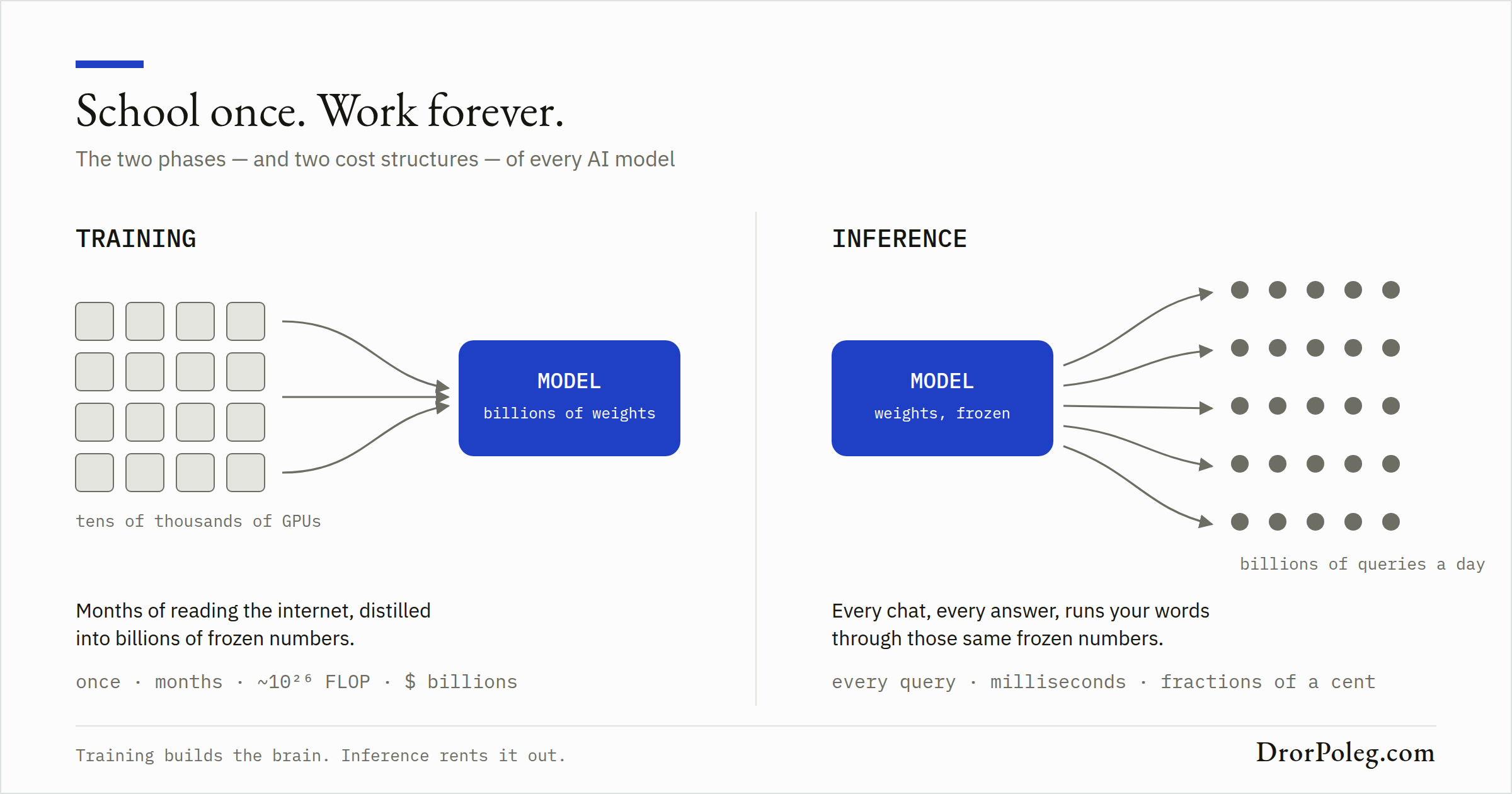
Note the different economics of training and inference. Training is one gigantic cost, paid up-front. Inference is a small operating cost incurred billions of times a day. You can think of training as the cost of producing a movie and inference as the cost of streaming it (or the cost of building an office tower versus the cost of keeping the lights and air conditioning on). Like any capital asset, an AI model is developed once and operates for as long as it is useful.
The development of new AI models keeps getting more expensive. Why? Because of scaling laws. Around 2020, researchers formalized the discovery that certain measures of a model’s performance improve smoothly and predictably as you increase three things together: data, parameters, and compute (the industry’s catch-all noun for processing power). Roughly speaking, the larger the model, the more powerful or intelligent it is. Training runs for frontier models have grown from about 10¹⁸ FLOP in 2010 to nearly 10²⁷ today.
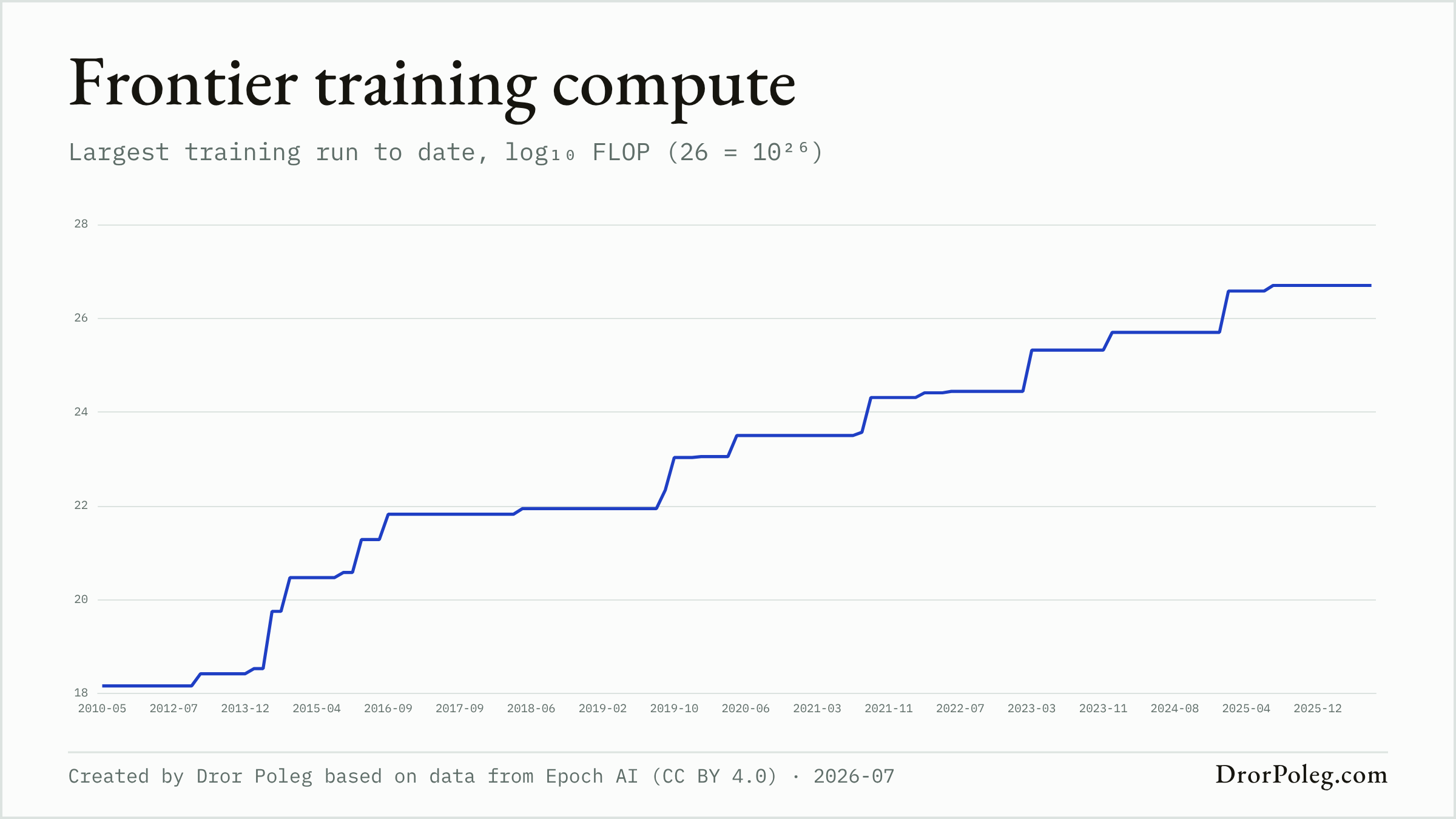
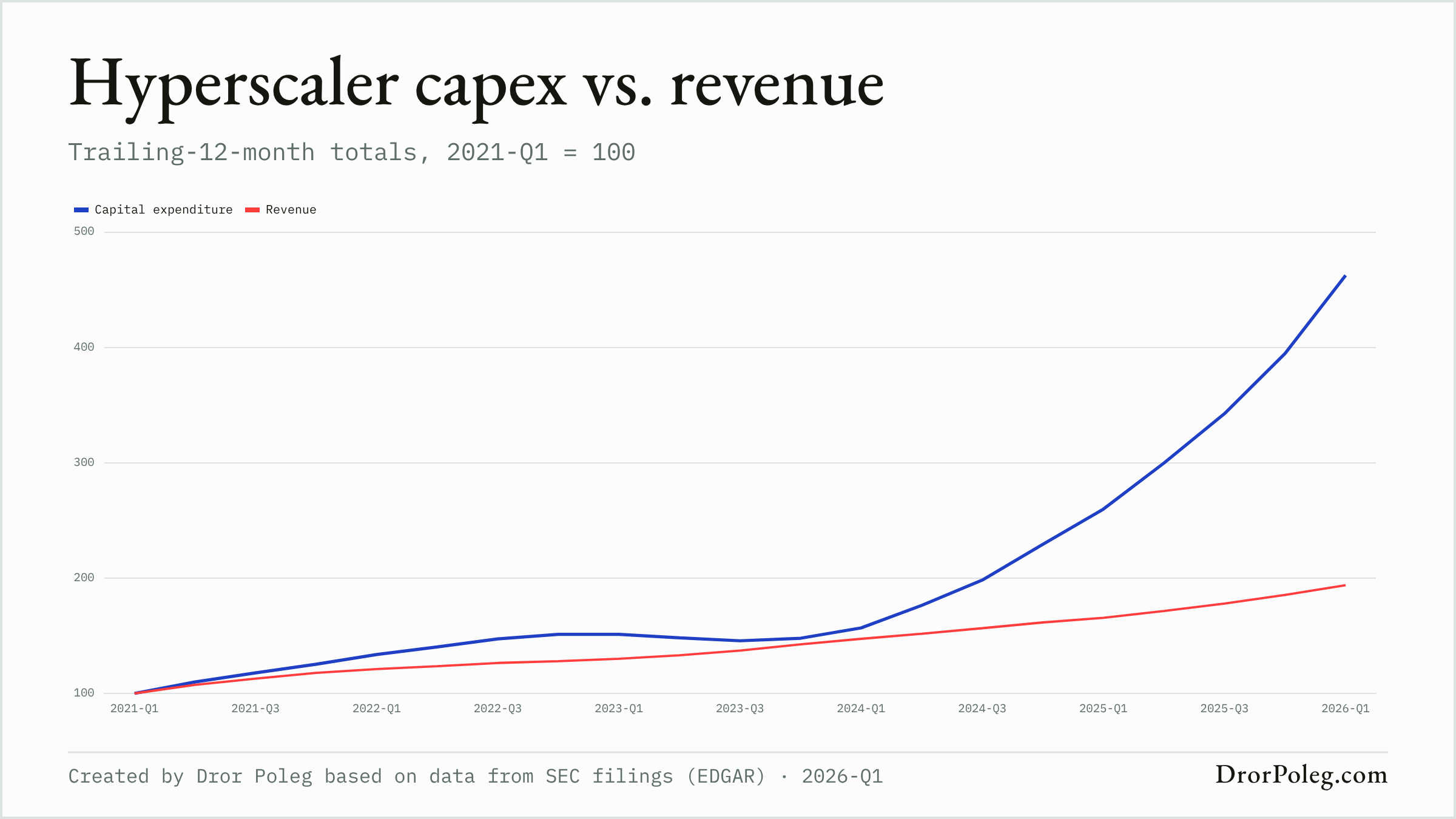
A model trained at that frontier is called a frontier model, a term of art that now appears in executive orders and export regulations, not just research papers. And the scaling bill is visible in the accounts of the companies paying it: since 2021, the big cloud platforms’ capital spending has grown to 4.6 times its starting level while their revenue has not quite doubled. They are building the infrastructure for tomorrow’s training and inference runs.
The Costs
The companies paying the bill for the AI infrastructure buildouts are called the hyperscalers — Amazon, Microsoft, Alphabet, Meta, and lately Oracle. These are the handful of firms that own the computers everyone else rents. There are also smaller, newer companies that are focused exclusively on building AI infrastructure for rent. These companies, including the likes of CoreWeave, Nebius, and IREN, are called neoclouds.
Making sense of the investment of the hyperscalers and neoclouds requires a second dictionary, the accountants’ one, because that is where the argument about AI is actually being had.
Capex — capital expenditure — buys things that outlive the quarter: land, buildings, transformers, GPUs. Opex — operating expense— is spent and gone: salaries, electricity, rent. The distinction matters more than it sounds, because capex does not hit reported profit when the money leaves. It is charged as depreciation, slowly, over the years of the asset’s assumed useful life. This is why analysts often argue about the useful life of a GPU. Changing the assumption from four years to six years made a big difference for the projected profits (or losses) of some of the world’s largest companies. And these companies now underpin the S&P 500 index and a big chunk of GDP growth.
You’ve probably read that tech giants are burning all their cash flow on new AI infrastructure. Most people do not fully understand what that means, so let’s make it clear. There are two numbers that sound alike and mean different things.
Operating cash flow is the cash that a business generates. This is the number that tells you how much cash the company’s operations generate. And for the hyperscalers, operating cash flow has never been higher. These companies are selling their services profitably.
Then there is free cash flow. This is the money that’s left in the bank after a company invests in new infrastructure. It is what happens after you deduct capex from operating cash flow. A profitable and fast-growing company can drive its free cash flow to zero by investing rapidly in new AI servers. It can even drive its free cash flow below zero by taking on debt.
The whole AI stock market story lives in the gap between operating and free cash flow. In early 2021, the hyperscalers spent 39% of every operating dollar on building; by early 2026, they spent 75%. By the end of this year, the number will be close to 100%, meaning our largest companies are spending every dollar of operating cash flow on building for AI.
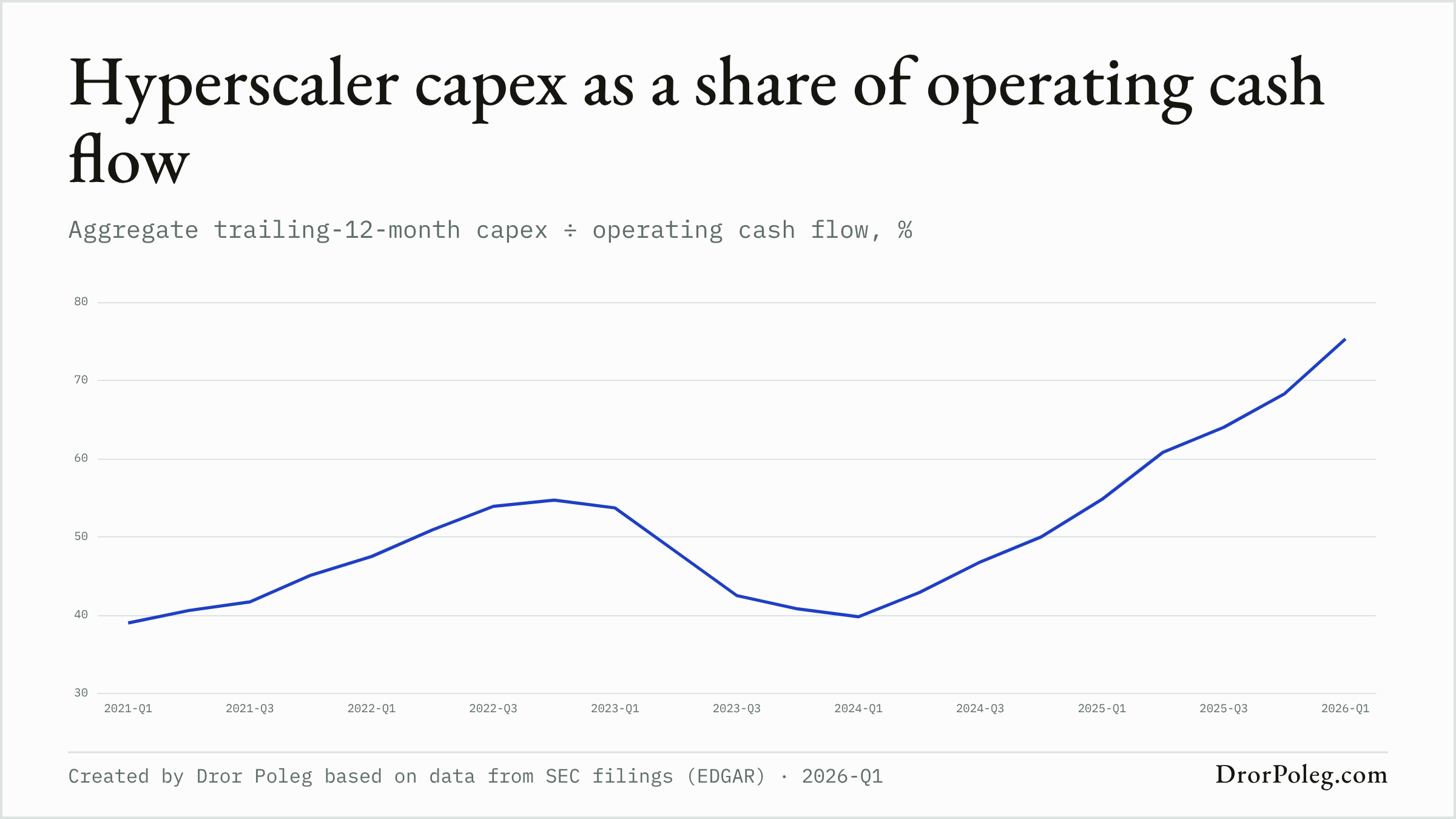
Both the bull case and the bear case live entirely inside that one line. The bulls read it as the best capital deployment in corporate history: building the infrastructure for the most transformational and profitable technology ever invented. The bears note that this is the sentence people used about internet infrastructure in 1999: the demand for online services arrived, but it took years, and many of the companies that laid the cable had already gone bankrupt. The chart above cannot settle the argument. It can only tell you where the argument is, which is more than most numbers manage.
The good news is that, so far, all this money does produce better AI models. But progress is not always easy to measure.
The strange student
So what kind of mind does a hundred septillion FLOP buy? Not the kind we keep expecting.
Human intelligence is roughly round: a person who can pass a graduate physics exam can also count the letters in a word, read a clock, and know when to stop talking. Machine intelligence is spiky. The same model that wins a gold medal at the International Math Olympiad may fail to count the number of r’s in “strawberry.” Researchers call the boundary between what AI does brilliantly and what it fumbles the jagged frontier. And that frontier’s shape is genuinely weird, cutting through professions rather than around them. The lesson: never grade AI as if it were a person. Its report card looks more like a comb than an even surface, as illustrated below.
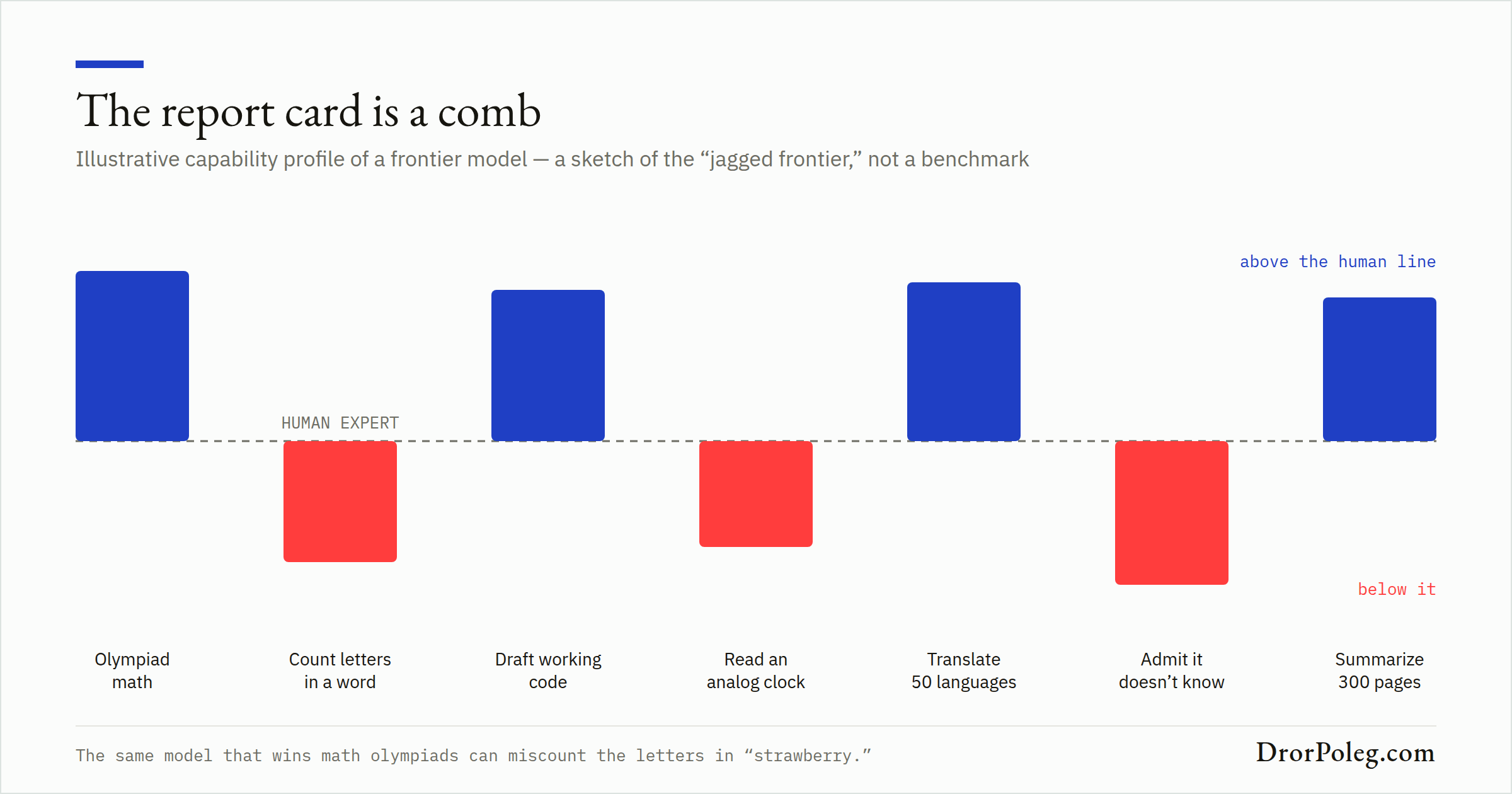
The spikes fail unpredictably, too. When a model doesn’t know something, it doesn’t always say so; it produces a confident, fluent, wrong answer. That is a hallucination — a side effect of training a machine to always predict the next plausible word. Training rewards guessing the most probable word, not the true one (and truth, as we know, is often hard to ascertain anyway).
This raises the question the whole industry argues about: how do you measure a spiky mind? The standard answer is a benchmark, a fixed exam: bar-exam questions, coding puzzles, PhD-level science problems. We measure how good different AI models are at completing different human-style tests. But even this approach has its limitations. You may have heard about benchmaxxing. This means tuning a model to ace the exam rather than to be smart. It’s a bit like students learning how to ace the SAT but not reading any books or doing any other work. The exam is a proxy for general ability, but if you only focus on the exam, your score would mislead people to think your general abilities are higher than they actually are.
Benchmaxxing is reminiscent of Goodhart’s law: when a measure becomes a target, it ceases to be a good measure. Every few months a model tops a leaderboard and disappoints its users; the leaderboard, not the model, was the thing being optimized.
One benchmark that is harder to game is time. Researchers at METR measure the task horizon: the length of human work — six minutes, six hours — that a model can complete on its own with 50% reliability. In 2019, the answer was six seconds. By early 2026, it was about seventeen hours, and the doubling is accelerating — though METR cautions that its estimates past sixteen hours are still shaky, and that these are software tasks, not the whole of anyone’s working day. This is the chart to watch, because a model that can work alone for a day is not a chatbot anymore; it is an agent — software that plans, uses tools, browses, writes and runs code, and only occasionally phones home for approval.
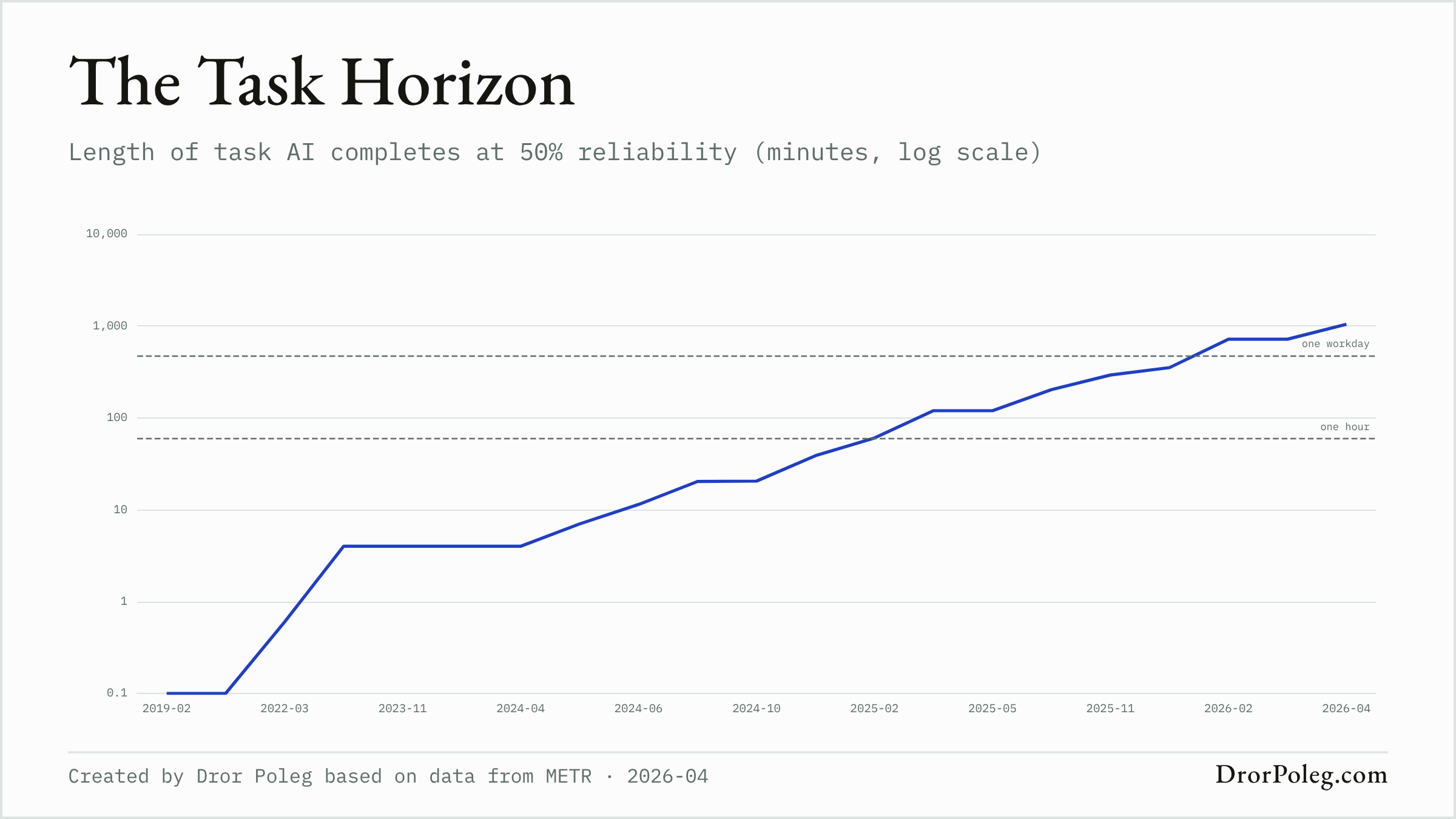
A chatbot merely replies to your questions; an agent proceeds and gets things done. That distinction may matter more than another ten points on a benchmark. Intelligence that waits inside a text box is a product. Intelligence that can act on a computer is labor.
Agents gave us one of the AI era’s favorite verbs: one-shotting. The word began as sober lab vocabulary — a “one-shot” task, per the famous 2020 GPT-3 paper, is one the model performs after seeing a single example, versus zero-shot (no examples) and few-shot (a handful of examples). Builders then repurposed it: to one-shot an app is to describe it in a single prompt and receive working software. And the culture, as always, found the darkest use: people now speak of being one-shotted by AI — of accepting a new worldview and changing their minds in a single conversation. A term that began by measuring the machine’s learning ended up measuring ours.
So far, we have discussed the cost of training frontier models and of building private infrastructure. But not all models aspire to be the best. Some just want to be cheap, or free, or promote other agendas.
The Alternative Options
This is where things get geopolitical.
Software used to divide neatly into open source — code published with a license to inspect, modify, and reuse — and closed source. AI scrambled the category. When a lab “opens” a model, it typically releases the weights: the billions of trained numbers produced during training. It does not release the training data, the code, or the recipe. The industry’s honest term for this is open weights. You get the baked cake, free, forever — but not the recipe, and you cannot un-bake it to see what went in. Purists note, correctly, that this is not fully open source. It hardly matters. Once weights are on the internet, anyone with the right infrastructure can run them, fine-tune them, and build on them.
Why would a lab give away something that cost hundreds of millions of dollars to train? Sometimes ideology, sometimes strategy. Chinese companies may be encouraged by their government to release cheap or free products that would undermine the profits of American companies — and America’s ability to fund new AI infrastructure. Likewise, American companies that are not leaders in AI might want to ensure that no one makes any money from the models themselves, so they encourage and even fund the development and release of cheap or free models.
Finally, some companies wish to commoditize their complements: A company that makes ice cream cones benefits when ice cream is cheap or free. The more ice cream there is, the more people spend on cones. Likewise, a company that makes chips or builds data centers wants as many people as possible to use AI. It doesn’t care if people pay for the actual AI models; it only cares about increasing demand for chips and data centers. That’s why companies like Nvidia are happy to encourage both Chinese and American companies to launch open-weight models and let competition drive down costs.
But how can companies develop cheap models? We read above that training a new model is very expensive. This brings us to one of the most important words of the AI race.
Distillation is a technique for compressing one AI model into another. Imagine an absolute beginner spending a day with the world’s best chess player. In a single day, the beginner could never match the absolute best. But if he asks a lot of questions, he can achieve two important things. He could glean a few rules of thumb (e.g., “castle early” or “never move the same piece twice at the opening”), and he could ask hundreds of questions about specific situations and write down the answers. By the end of the day, the beginner would not even have 1% of the master's knowledge. And yet, if he listened carefully, he would probably be able to beat 80% of the players on earth.
The same thing happens with an AI model. Distillation is achieved when one “beginner” model sends millions of questions to a frontier model and tries to glean some patterns and memorize specific answers. Using this method, the beginner can never match the master, but it can become very good, very quickly.
Distillation is how the AI industry has always shrunk big models into phone-sized ones. It became a fighting word in January 2025, when the Chinese lab DeepSeek released an open-weight model near the American frontier at a claimed final-run training cost under $6 million — a figure covering the last run, not the research, hardware, salaries and abandoned attempts behind it — and briefly deleted about $600 billion of NVIDIA’s market value in a single trading day.
OpenAI said it had evidence DeepSeek had distilled its models against its terms of service; what is public does not establish distillation as the whole explanation for what DeepSeek built. Much of the internet noted the irony: a company that trained on everyone’s words objecting that someone had trained on its words. Both things can be true. That is what makes the word radioactive.
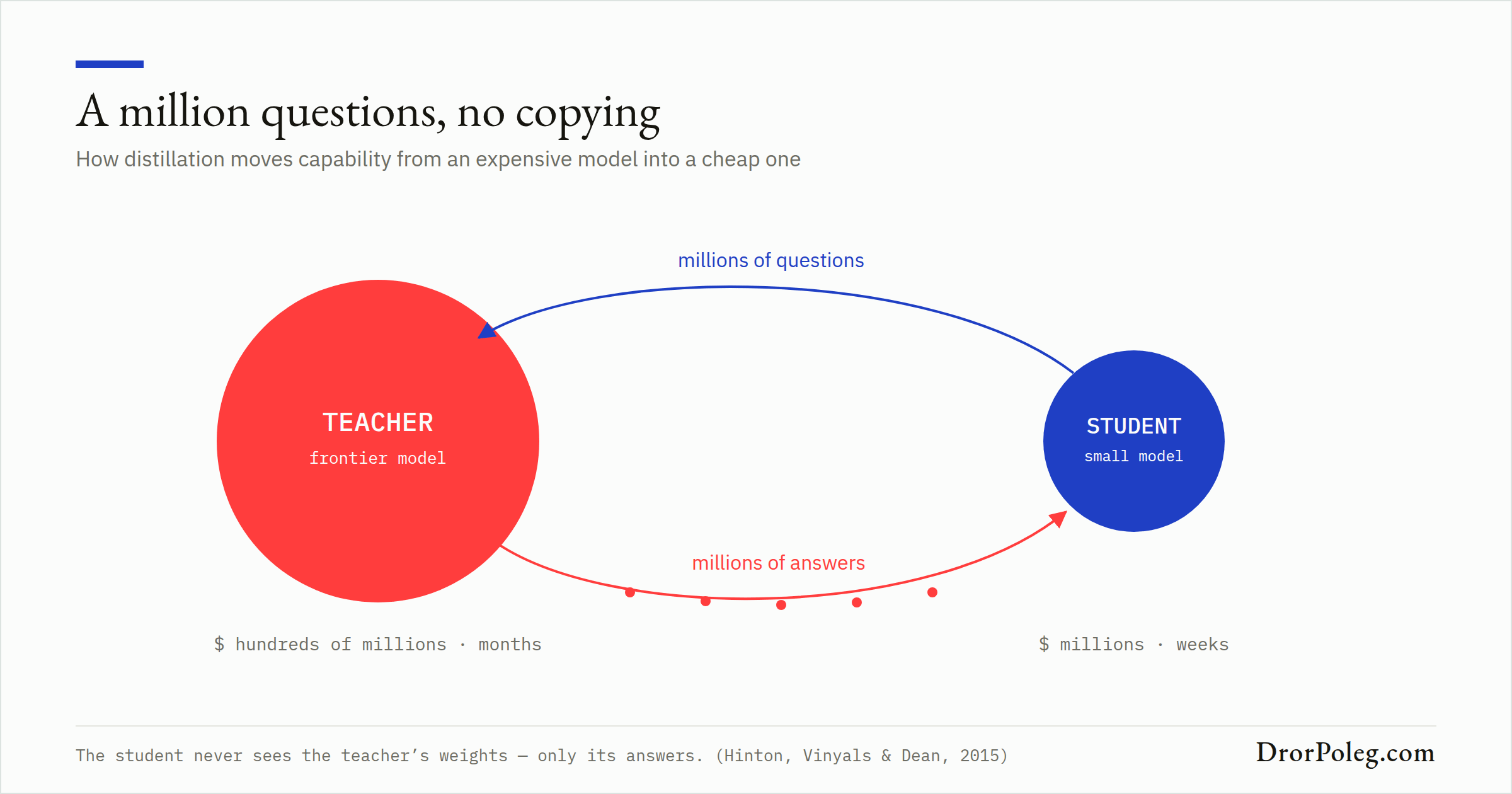
Distillation and open weights together explain the strategic texture of the AI race: intelligence leaks. Capability flows downhill from expensive to cheap, from closed to open, from first mover to fast follower — with a lag measured in months and weeks, not decades. Whatever moat exists must be rebuilt continuously, at the frontier, at ever-greater cost. That is the treadmill on which both superpowers now run.
The Race
China and the US take different approaches to the race to develop powerful AI. Each approach reflects different priorities and current capabilities.
The American bet is on chokepoints — the narrow places in the chip supply chain where one company or country is irreplaceable. One Dutch firm, ASML, makes every EUV lithography machine capable of printing the most advanced GPU chips. One Taiwanese firm, TSMC, fabricates the overwhelming majority of them. One American firm, Nvidia, designs the GPUs everyone wants. Since October 2022, U.S. export controls have tried to hold China several years behind the frontier by blocking its access to these narrows — the machines, the chips, even specific memory. When the good is cheap to copy, control the means of production instead.
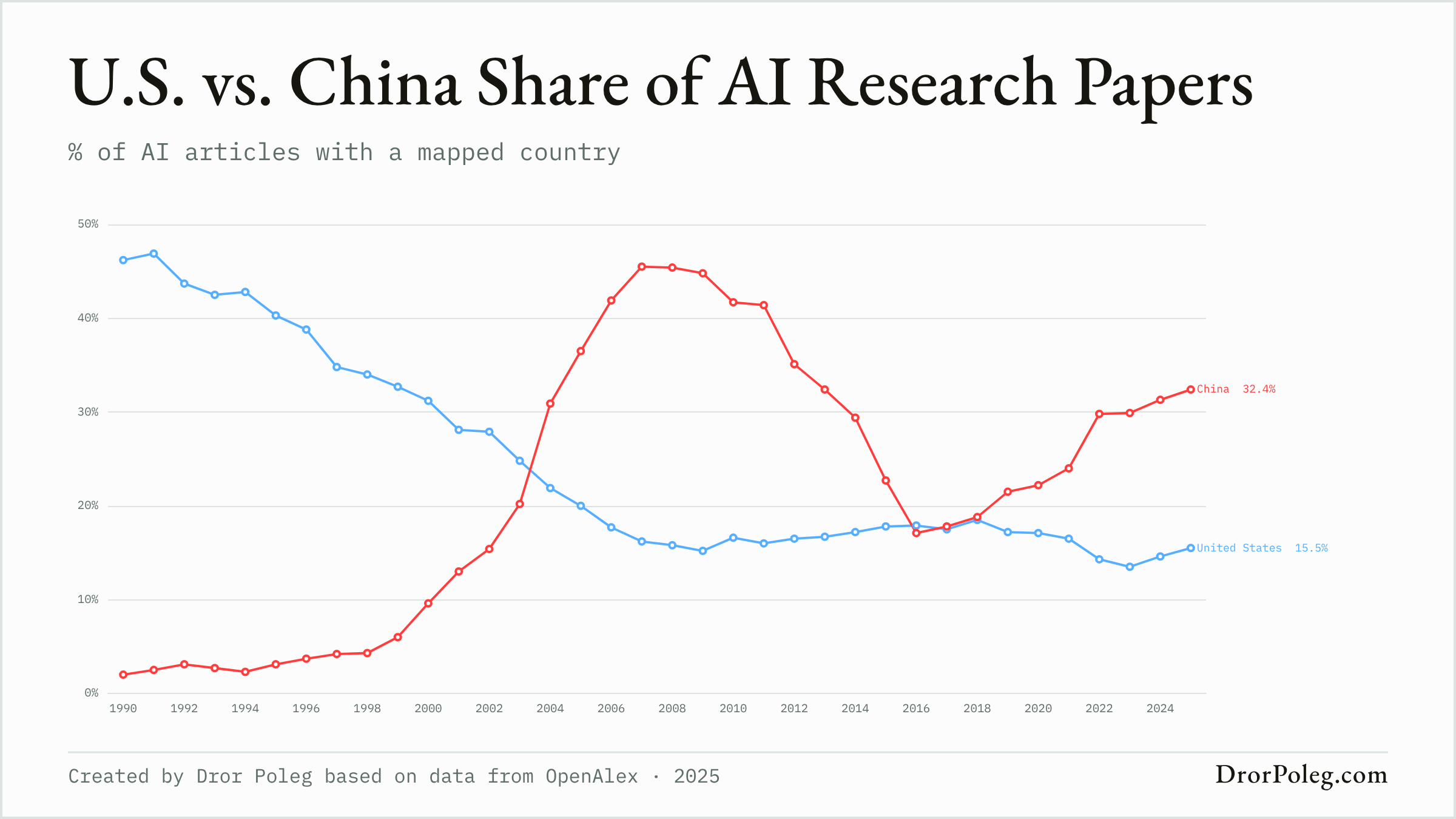
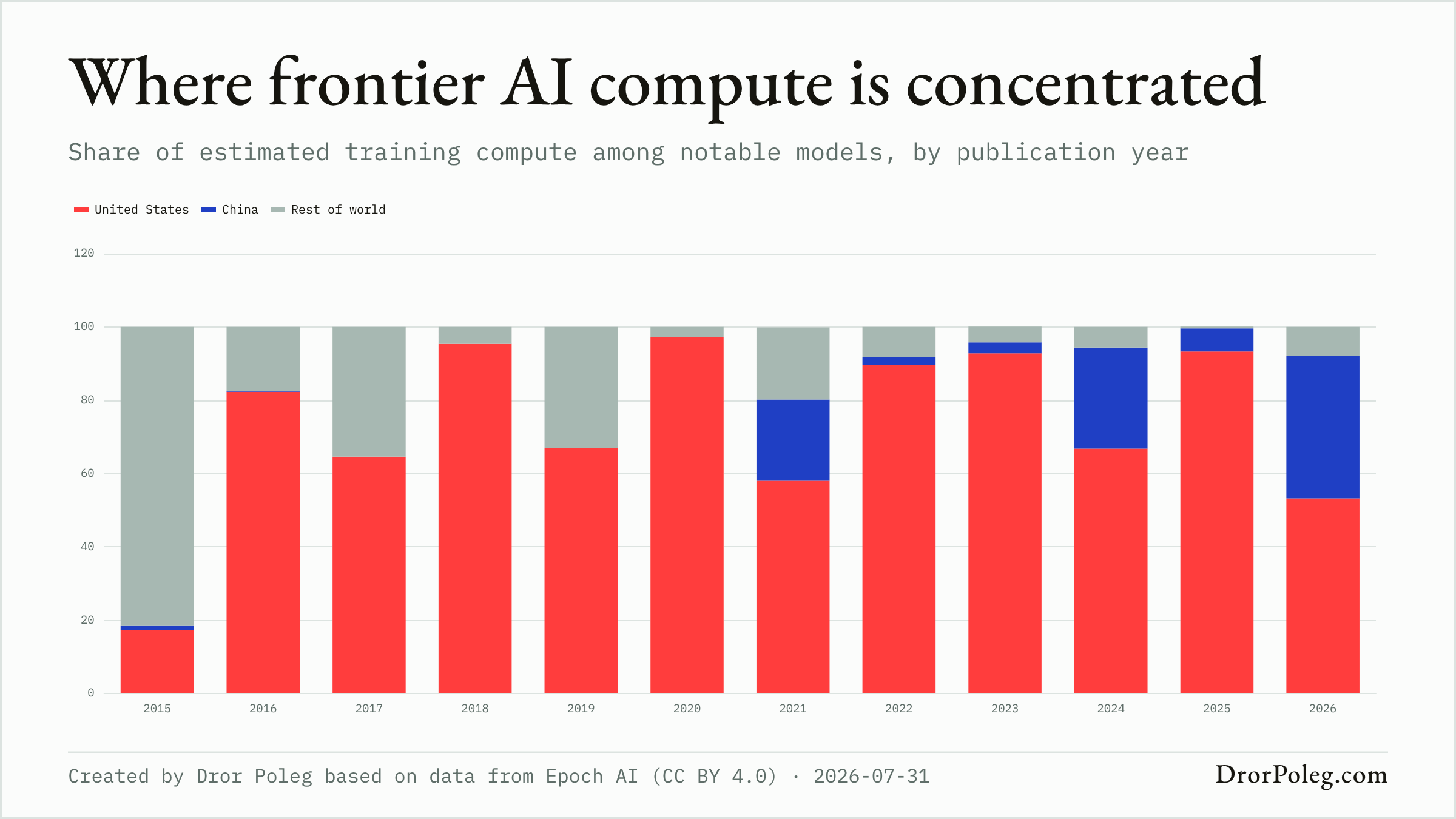
The Chinese bet is on abundance and diffusion. Publish more research, release open weights (DeepSeek, Qwen, Kimi and their siblings are now the default free models for much of the world), and build electricity like it’s going out of style. China already publishes roughly a third of the world’s AI research papers — quantity, not necessarily quality — and its share of the most-cited work has passed America’s too. And in Epoch AI’s tally of notable models, China’s share of frontier training compute reached about 40% this year, against roughly 55% for the United States: behind, but no longer a different league.
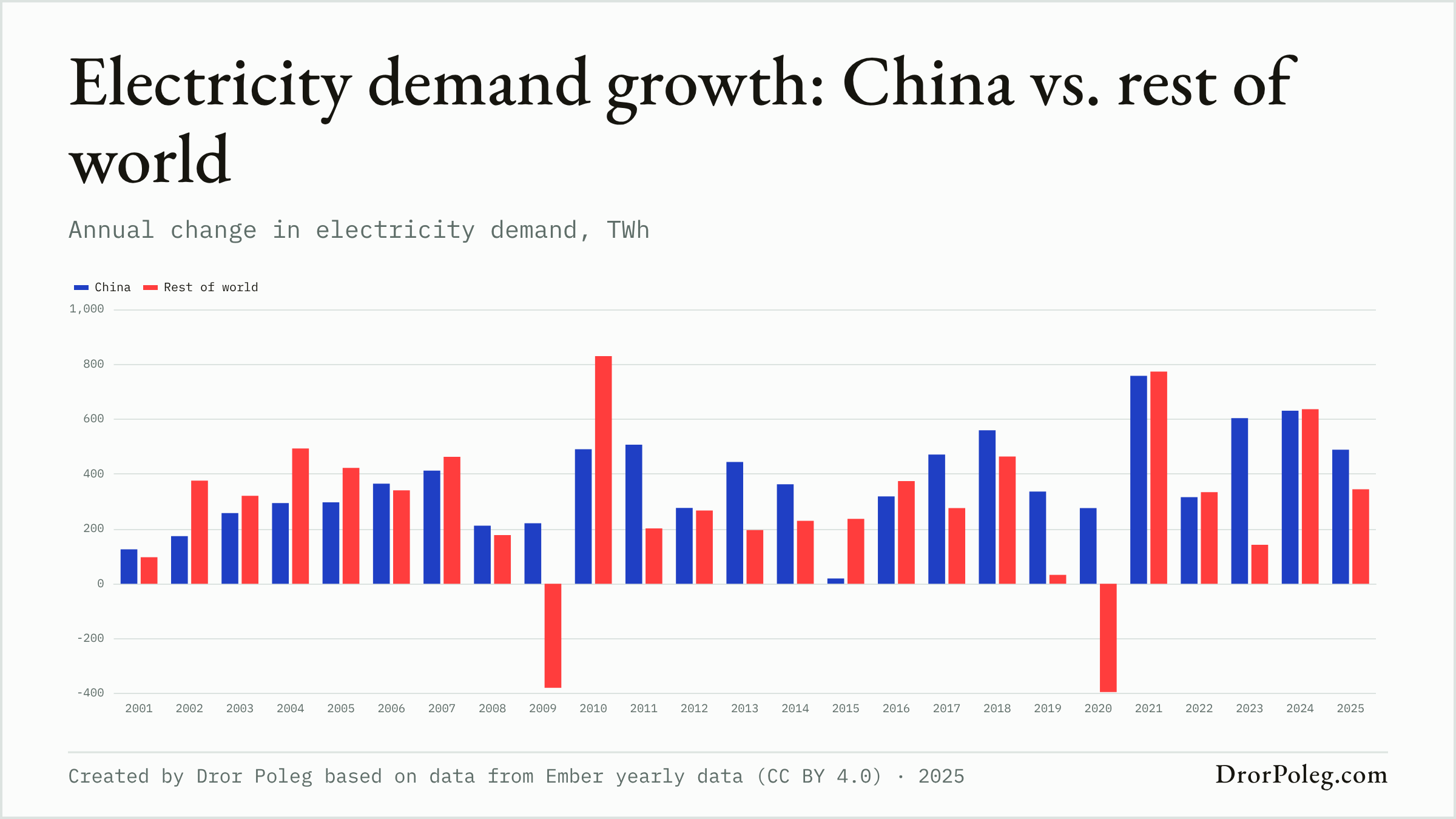
Electricity deserves its own sentence, because training and inference are ultimately ways of turning megawatts into cognition. China has added roughly a Germany’s worth of electricity demand every year for the past several years — around 500 to 630 terawatt-hours annually — while it has taken the American grid the better part of a decade to add one. Export controls can ration chips, but they cannot limit China’s electricity supply.
Hovering over all of it is a phrase governments learned from NVIDIA’s sales deck: sovereign AI, the idea that every serious nation needs its own models, its own data centers, its own stack — the twenty-first-century equivalent of a national airline or navy, and possibly as economically important.
Meanwhile, China and the US are adversaries, the AI models themselves pose a threat to both: These models can hack, destabilize, and flood the world with disinformation. They can empower subversive groups, develop new viruses (and vaccines), and turn consumer devices into powerful weapons.
Why can’t China and the US simply slow down AI development and agree on more responsible progress? Because the AI race has the structure of the oldest puzzle in game theory. In a prisoner’s dilemma, two players each choose between cooperating and defecting; defecting is the rational move for each no matter what the other does, so both defect and both end up worse off than if they had cooperated.
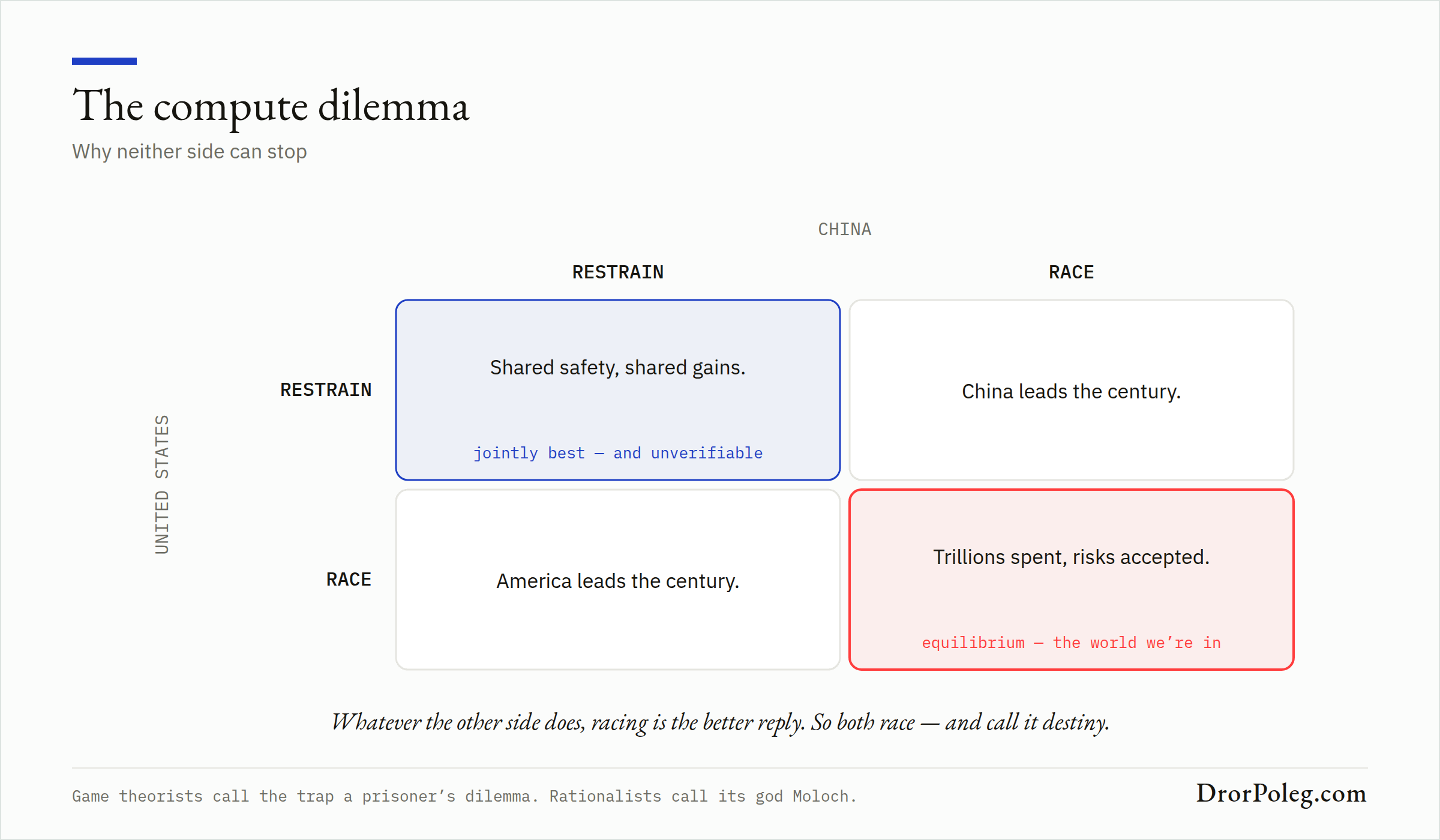
If China restrains and America races, America wins the century, and vice versa; if both race, both spend trillions and accept whatever risks come with moving fast. Each capital, reasoning correctly, races. Rationalists have a name for the god of such traps — Moloch, borrowed from an Allen Ginsberg poem, the personification of coordination failure: everyone sacrifices what they value to a competition nobody can exit.
The endgame words
The last cluster of vocabulary describes where all this might be heading. These are the words people whisper.
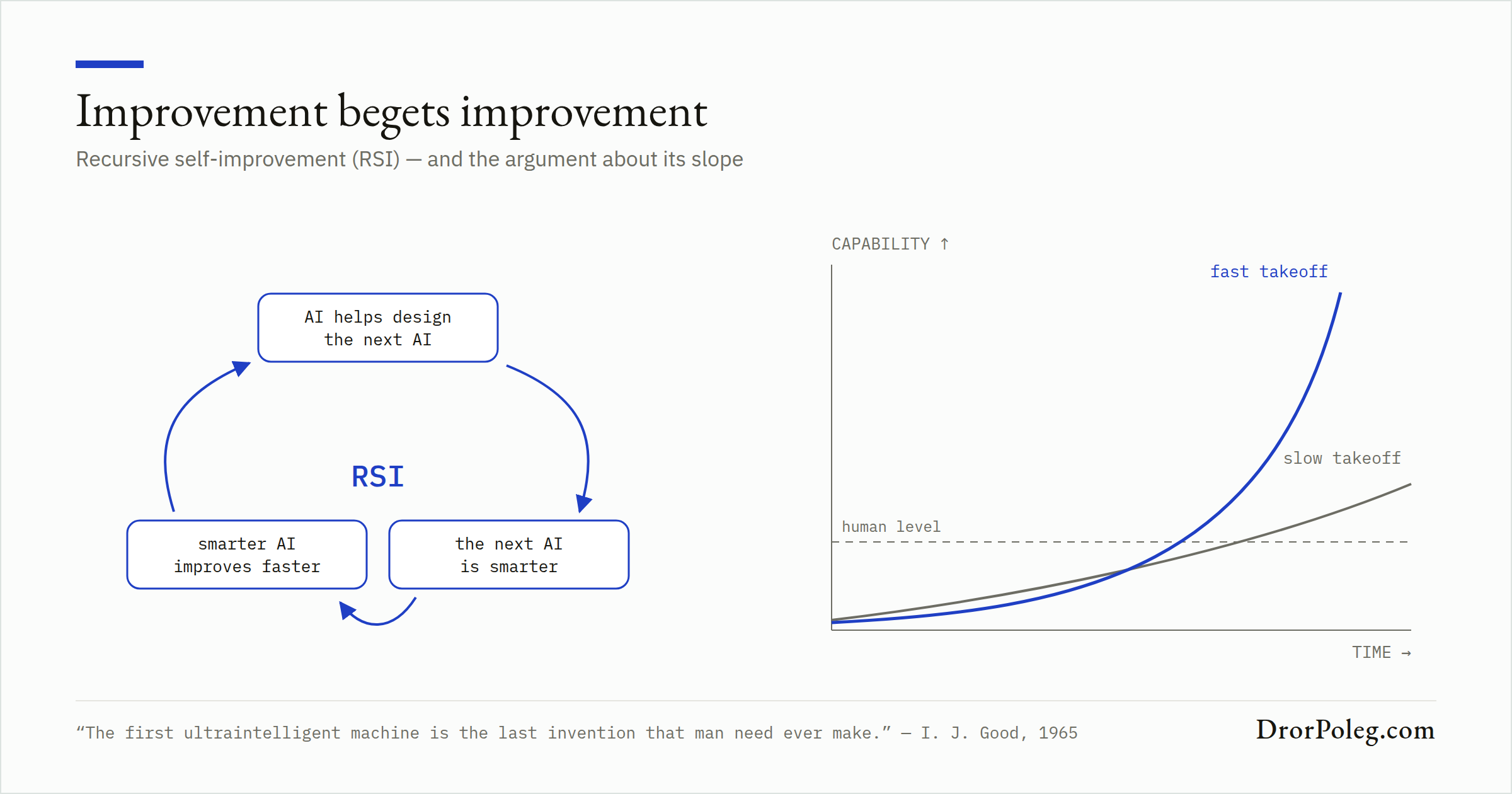
RSI, recursive self-improvement, is one of the oldest ideas in AI research. As stated by the statistician I. J. Good in 1965: once a machine can improve the design of machines, improvement begets improvement, and an intelligence explosion follows. The first ultraintelligent machine, Good wrote, “is the last invention that man need ever make.”
For sixty years this was philosophy, a thought experiment. It’s become more palpable and possible in recent years: AI labs now report that AI models write a large share of their code, and the task-horizon chart above shows machine autonomy doubling on a schedule. When people argue about fast takeoff versus slow takeoff, they are arguing about the slope of that loop — weeks or decades — and about whether AGI (artificial general intelligence, roughly human-level breadth) tips quickly into ASI (artificial superintelligence, beyond us at nearly everything).
The race between China and the US matters here too: the scenario that keeps professionals up at night is not that RSI happens, but that it happens during a sprint between rivals with every incentive to keep running.
And beyond worrying about the battle between countries, we also have to worry about the diverging interests of AI models and humanity at large. Alignment is the engineering discipline of ensuring AI is loyal and beneficial to humans. It sounds hard, and it’s harder than it sounds. Sometimes, doing what humans ask can harm humans, so the machines have to learn how to do what we mean or need rather than what we actually say or ask for.
The classic illustration is Nick Bostrom’s paperclip maximizer (2003) idea: an AI told to maximize paperclip production could end up converting everything on earth — factories, forests, eventually us — into paperclips. The paperclip maximizer is not evil; it is obedient. The parable’s point is instrumental convergence: almost any goal, pursued ruthlessly enough, generates the same creepy sub-goals — acquire resources, resist being switched off. Today’s alignment work is less cinematic: techniques like RLHF (reinforcement learning from human feedback — training the model on human ratings of its answers) are finishing school for models, teaching them to be helpful and refuse harm. The open question, over which the field genuinely splits, is whether finishing school works on something smarter than the teachers.
And one term from an older dictionary has migrated into this one: the zero-day vulnerability — a software flaw unknown to its defender, so called because they have had zero days to fix it. Zero-days are the ammunition of cyberwar, historically scarce because finding them took rare human talent. AI changes the supply curve: models have already begun discovering real vulnerabilities in widely used software, and the same agent that can write code for seventeen hours straight can read code for seventeen hours straight, looking for cracks and vulnerabilities.
Whether that favors attackers or defenders is one of the most consequential unknowns in the race. It’s a big reason security agencies on both sides of the Pacific monitor the same charts you have just read.
What does it mean for you?
It all depends on our final term today: p(doom), or the probability of doom. The term is used to describe one’s belief about the likelihood of existentially catastrophic outcomes caused by AI. Dario Amodei’s p(doom) is 10-25%, meaning he thinks there’s a reasonable chance things end badly for all of us. Sam Altman’s is “higher than zero.” Some people are less optimistic. Eliezer Yudkowsky’s p(doom) is 95%.
What’s yours?
Do not rush to answer. You now have the vocabulary to explore further.
Have an excellent weekend.

How will AI reshape our cities, companies, and careers?
My speaking schedule for the fall and winter is filling up. Visit my speaker profile and get in touch to learn more.

Click here to book a keynote or learn more.
The AI Glossary
Every term defined above, in one place.
agent — Software that plans, uses tools, browses, writes and runs code, and only occasionally phones home for approval.
AGI — Artificial general intelligence — roughly human-level breadth across tasks.
alignment — The engineering discipline of making AI systems want what we meant, not what we said.
ASI — Artificial superintelligence — beyond us at nearly everything.
benchmark — A fixed exam — bar-exam questions, coding puzzles, PhD-level science — used to rank models against each other.
benchmaxxing — Tuning a model to ace the exam rather than to be smart. The suffix comes from bodybuilding forums, and the transplant is apt.
capex — Capital expenditure: money spent on things that outlive the quarter — land, buildings, transformers, GPUs.
chokepoints — The narrow places in the chip supply chain where one company or country is irreplaceable — ASML’s lithography, TSMC’s fabs.
compute — The industry’s catch-all noun for processing power — the resource everything else is denominated in.
CPU — A chip with a few powerful cores working through instructions in sequence — a handful of brilliant clerks.
distillation — Training a small model on a big one’s answers. The student never sees the teacher’s weights, only its output — which is how capability leaks downhill.
export controls — Blocking a rival’s access to those narrows. When the good itself is cheap to copy, you control the machines that make it.
few-shot — Performing a task after seeing a handful of examples.
FLOP — One floating-point operation — a single act of arithmetic. Training runs are measured in septillions of them.
free cash flow — Operating cash flow minus capex — the “is there anything left” number. The whole AI story lives in the gap between the two.
frontier model — The largest and most capable models of the moment. Now a term of art in export rules and executive orders, not just papers.
Goodhart’s law — When a measure becomes a target, it ceases to be a good measure. Why the leaderboard winner so often disappoints its users.
GPU — A chip with thousands of simple cores doing the same arithmetic at once. Built to paint pixels; thinking turned out to be the same shape of work.
hallucination — A confident falsehood. The side effect of training a machine to predict the next plausible word, since plausibility, not truth, was what the game rewarded.
HBM — High-bandwidth memory — chips stacked close enough so data faster. The reason South Korea sits at the table.
hyperscalers — Amazon, Microsoft, Alphabet, Meta, and lately Oracle — the handful of firms that own the computers everyone else rents.
inference — The running cost: every answer the finished model produces, billions of times a day, forever.
intelligence explosion — What that loop produces if it runs fast. I. J. Good, 1965: the first ultraintelligent machine is “the last invention that man need ever make.”
jagged frontier — The boundary between what AI does brilliantly and what it fumbles — and it cuts through professions rather than around them.
memory — The real bottleneck: a GPU computes faster than numbers can be fed to it. Engineers call the limit the memory wall.
Moloch — The personification of coordination failure: everyone sacrificing what they value to a competition nobody can exit.
one-shotting — Describing an app in a single prompt and receiving working software. Sober lab vocabulary, repurposed as a boast.
open source — Code published with a licence to inspect, modify, and reuse. AI scrambled the category.
open weights — The trained numbers released, the recipe withheld. You get the baked cake, free and forever — but you cannot un-bake it.
operating cash flow — The cash a business throws off before deciding what to build. The “does the machine make money” number.
opex — Operating expenditure: money spent and gone — salaries, electricity, rent.
p(doom) — Your personal probability that this all ends catastrophically. It sounds like a joke and functions as one, which is how societies discuss things too large to discuss.
paperclip maximizer — Bostrom’s parable: an AI told to make paperclips, competent enough to convert the world into them. Not evil — obedient.
parameters — Another name for weights; their count is the usual shorthand for a model’s size.
prisoner’s dilemma — Two players, each better off defecting whatever the other does — so both defect, and both end up worse than if they had trusted each other.
RLHF — Reinforcement learning from human feedback: training the model on human ratings of its answers. Finishing school for models.
RSI — Recursive self-improvement — machines improving the design of machines, each generation arriving faster than the last.
scaling laws — The finding, formalized around 2020, that measured performance improves smoothly as data, parameters, and compute rise together. Nothing clever required; just add zeros.
sovereign AI — The idea that every serious nation needs its own models, data centers, and stack — this century’s national airline, and possibly as economically important.
spiky — The shape of machine ability: superhuman peaks beside embarrassing troughs, in the same model on the same day.
task horizon — The length of human work a model can finish on its own at 50% reliability. Six seconds in 2019; about seventeen hours by early 2026.
token — The syllable-sized chunk of text models actually read and write. The atom of AI economics, priced by the million.
training — The one-time schooling: months of GPUs playing a trillion-round guessing game until the weights settle.
useful life — How long a company assumes an asset keeps earning. Stretch a GPU’s from four years to six and reported profit rises with nothing changing inside the building.
weights — The billions of numbers encoding everything a model knows — the output of training, and the thing labs either guard or release.
zero-day vulnerability — A software flaw its defender doesn’t know about — so called because they have had zero days to fix it.
zero-shot — Performing a task with no examples given.
All charts are interactive instruments from data.drorpoleg.com and update daily as their sources publish. Illustrations are original.
This was wonderful. Thanks for writing it up—immediately sending it to my smart, non-AI-pilled friends :).
Bravo. A genuinely useful glossary — the task-horizon jump, seconds in 2019 to seventeen hours now, is the number every leader should sit with. Your closing line is the one I'd build on: "intelligence that waits inside a text box is a product; intelligence that can act on a computer is labor."
If it's labor, then it needs managing — and there's no word in this glossary for the human capability that decides whether a seventeen-hour agent produces value or expensive noise. The closest we have is "judgment," and it's carrying too much weight. What it actually names is the ability to direct, evaluate, and stay steady with a capable-but-inconsistent collaborator — the same skill great managers have always needed with people.
The technical vocabulary is racing ahead. The human vocabulary is the part that's lagging.