


It’s that time of year again. Summer is over, kids are back in school, and everyone is finally back to the office. Or at least they were supposed to be. I have fond memories of Jamie Dimon’s May 2021 prediction that by “sometime in September” office attendance would “look just like it did before.”
Dimon went on to build New York City’s most formidable office building, and even I showed up there recently to pay my respects and give a keynote about — what else — the future of work. The JPMorganChase Tower is as attractive a workplace as you’ll find. It sits above multiple subway and regional train lines, in the heart of Manhattan, within an easy walk to any type of restaurant or service you might need, and it is filled with amenities and conveniences you won’t find even at home.
And yet, for better or worse, nothing looks “just like it did before.” Six years after the first calls to “return to office”, most workplaces across America and the world have yet to fully recover. Moody’s puts the national vacancy rate around 21%, meaning more than a fifth of office space is completely unleased. This figure does not account for space that is paid for but unused or underused. Placer’s analysis of mobile phone movement puts office visits at 32% below their pre-COVID levels. And Kastle’s access control data puts office occupancy in the largest cities at around 50% below “normal.”
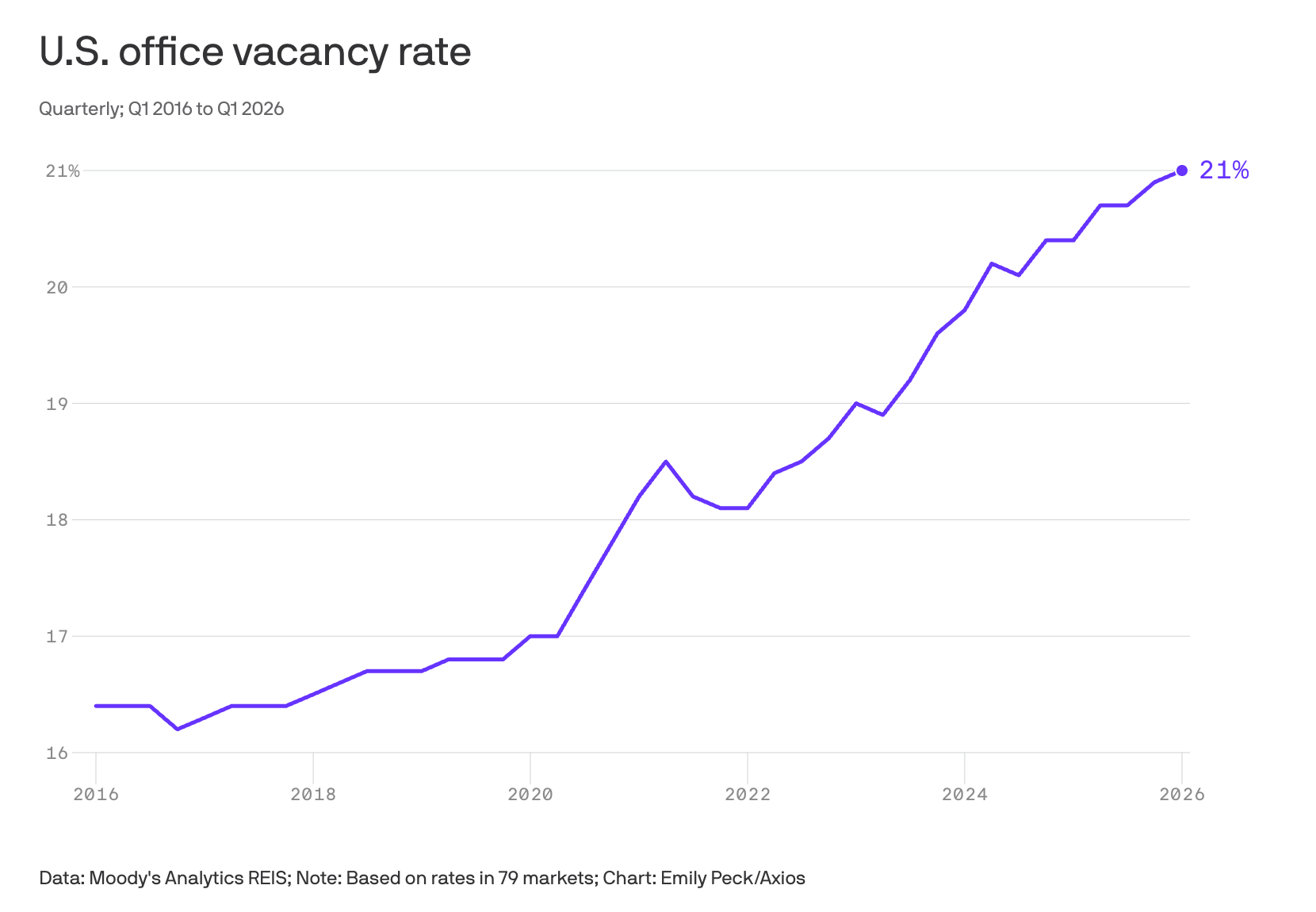
Most people assume the office story is over: it bottomed out a couple of years ago and has been slowly recovering since. But even if occupancy recovers, the office won't return to normal. The relationship between business growth, employment, and office demand has changed, and it's still changing.
Why?
Depending on whom you ask, it’s remote work, or AI, or interest rates, or a hangover from COVID over-hiring that has nothing to do with technology or finance. They’re all partly right. Work has become more remote, distributed, scalable, and uncertain, and AI is intensifying all four.
Here’s my read of where we are, how we got here, and what happens next.
Remote Work
Remote work used to be controversial. In August 2019, months before COVID, I wrote in my book that:
“Office landlords are facing an unprecedented abundance of supply. This abundance is not the result of new construction. Rather, it is the result of individuals’ ability — and desire — to work from anywhere.”
At the time, office rents and occupancy were close to their all-time highs; WeWork was gearing up for its IPO, and predictions that remote work would make a dent in office demand had failed to materialize for two decades. But beneath the surface, clear signs showed something had changed: a few companies began hiring more heavily from anywhere. They did so to find specialized talent, not cut costs. And they were collaborating in ways that finally seemed to work.
These undercurrents mattered, but real change remained invisible. Yet anyone who follows trends knows the most important ones can't be followed, because they don't happen gradually. In 2018, I wrote:
“Technology does not revolutionize industries gradually. It waits for a crisis, and then it pounces... A whole new real estate market will emerge from the next one.”
Once COVID forced offices to shut down, the collaboration technologies that matured during the previous five years were suddenly imposed on all office workers. It didn't matter whether you were an early adopter — you were suddenly joining meetings on Zoom, sharing files on Google Drive, and catching up on the latest company gossip on Slack.
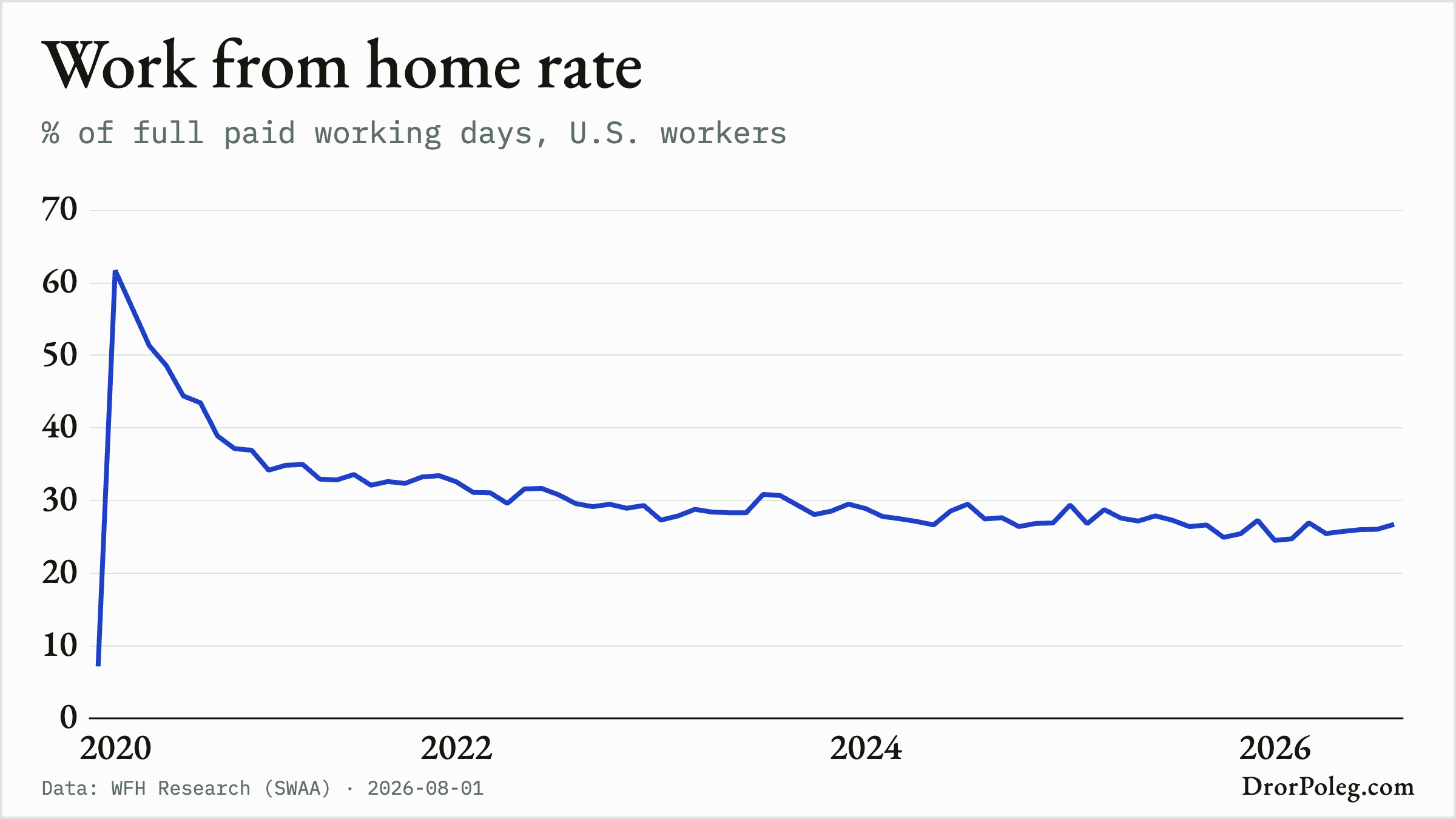
These new behaviors stuck. Lockdowns were lifted, vaccines were rolled out, schools reopened, and life began to return to normal. But a massive share of workers have not returned to their pre-pandemic work habits. As Nicholas Bloom and his colleagues meticulously document, more than a quarter of paid working days in the U.S. are delivered “from home,” up from around 8% in 2019.
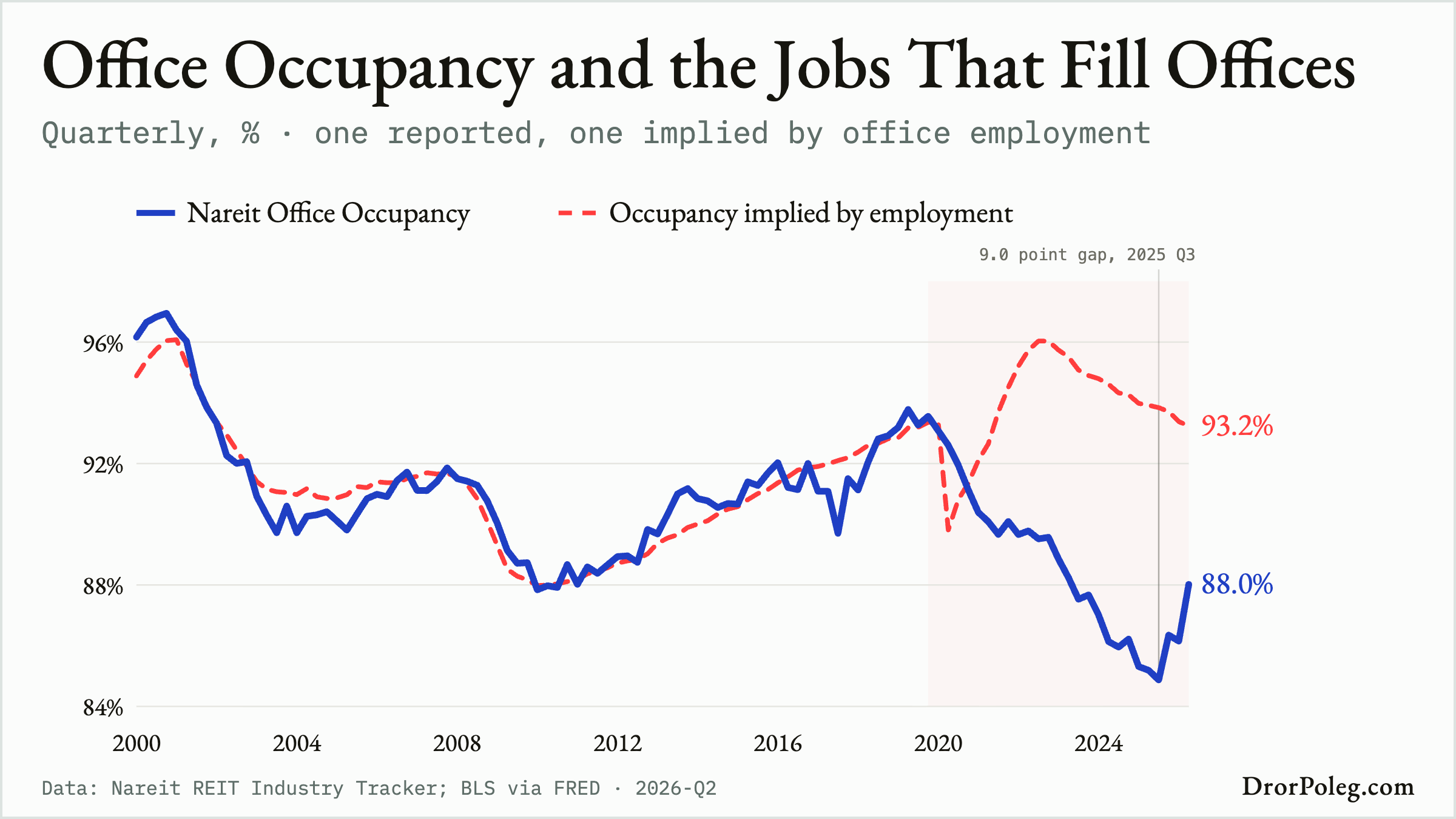
Remote work made the first crack in the historical relationship between employment and office demand. The chart below shows office occupancy compiled by Nareit, the national association of publicly listed landlords who tend to operate larger, higher-quality properties. The red line fits the relationship between office-based employment and office occupancy from 2000 to 2020. After 2020, employment recovers quickly and rises, implying a rapid bounce in office demand and occupancy. Meanwhile, actual office occupancy does not begin to recover until 2025.
AI plays into the remote work trend in several ways. AI makes online collaboration easier. It also makes more online collaboration necessary: As more of our work happens in cloud-based tools like ChatGPT and Claude, less of our work happens offline using physical spaces and tools. Even if our colleague is sitting next to us, our work is mediated through the cloud. Once work is mediated through the cloud, it becomes easier to collaborate with colleagues who aren't sitting next to us—at least part of the time.
This process also benefits AI: the more we collaborate online, the more data we generate to train better AI models. And the better the models, the more we collaborate online. There is a flywheel effect that turns more collaboration and data into better and cheaper tools… into more collaboration and data.
This does not mean that as AI adoption grows, everyone will ultimately work from home. But it does mean that work will become more distributed.
Distributed Work
By Distributed Work, I mean work that is performed across multiple locations. As I put it in 2019 in Rethinking Real Estate:
“The office of the future is not a single location; it is a network of spaces and services.”
Around 2015, I noticed that some of the largest, fastest-growing, and most innovative companies began splitting their headquarters into multiple locations. Famously, Amazon did so with its HQ2 saga, but other companies did too, including Apple, Meta, Google, and Stripe.
On the surface, this does not seem like a big deal. After all, large companies have had offices across multiple cities and countries for decades and even centuries. But something fundamental was different here: These companies were not opening branch offices, sales offices, or a single department. They were splitting their core research and development and management across these locations. They took teams that used to have to be in the same place, and split them into two or more locations. This implied that a new form of remote collaboration was suddenly possible and even desirable for some companies. And specifically, for companies that were moving faster, producing more innovation.
My pre-COVID analysis also drew on early insights from Steve Jobs. As early as 1990, Jobs identified something important about how work should be done. As he told an interviewer:
“As business conditions change faster and faster each year, we cannot change our management hierarchical organizations very fast relative to changing business conditions. We can’t have someone working for a new boss every week. We also can’t change our geographical organization very fast... We can’t be moving people around the country every week.
But we can change an electronic organization, like that [snaps fingers]… we are starting to be able to create clusters of people working on a common task in literally 15-minutes’ worth of setup. And these people can work together extremely efficiently no matter where they are geographically and no matter who they work for hierarchically. And these “organizations” can live for as long as they’re needed and then vanish.
We’re finding we can reorganize our companies electronically very rapidly, and that’s the only type of organization that can begin to keep pace with changing business conditions.”
As was often the case, Steve Jobs’ description was far more exciting than the reality on the ground. In 1990, people at NeXT and Apple still worked mostly from a single office. But digital collaboration enabled a new — if modest — way to constantly mix and match talent and resources. The important thing was that Jobs understood what companies needed. By the mid-2010s, the technology to enable this type of corporate collaboration was finally ready, and more companies were taking advantage of it.
The organizational flexibility Jobs described is now visible at some of the fastest-growing companies:

OpenAI already employs thousands of people. Its ability to assemble teams around urgent problems illustrates how flexible a large organization can become. Geographic flexibility is a separate development, and one we can measure across a much broader range of employers.
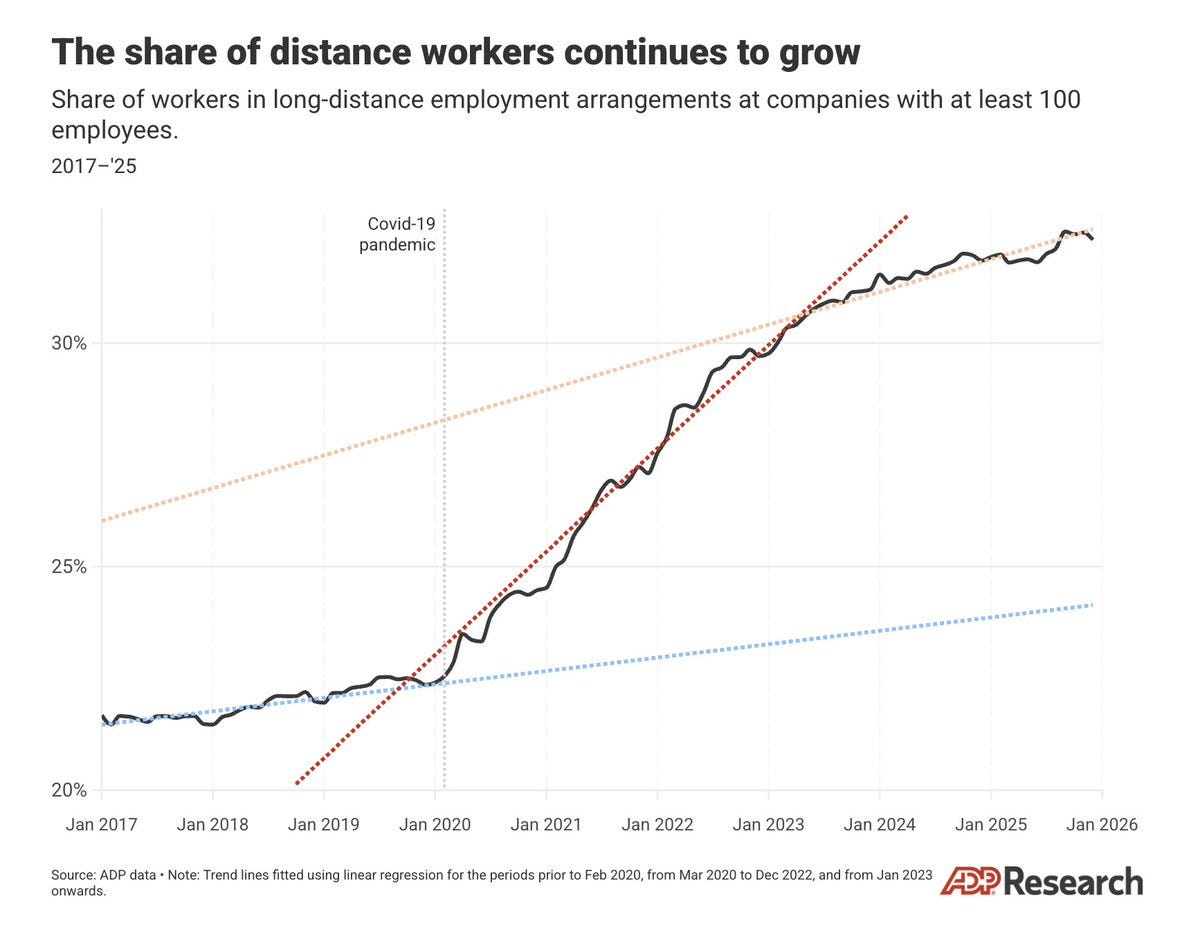
The latest research from ADP’s Issi Romem and Łukasz Below found a dramatic expansion of the share of employees who report to a manager in a completely different metro area. These are not merely people in the same company who work in different departments or branch offices, but members of the same team who are located in different cities and collaborate remotely regardless of whether they do so from home or from an office. And the data is drawn from a broad subset of US companies.
An even more dramatic illustration comes from San Francisco’s Chief Economist, Ted Egan. His office used the city’s tax filings to track tech companies that were based in San Francisco before COVID. In 2018, the average company in this group had about 44% of its payroll in the city. By 2024, that share had fallen to about 10%. They’re still San Francisco companies. But the average SF company now pays about 90% of its wages to people working somewhere else.
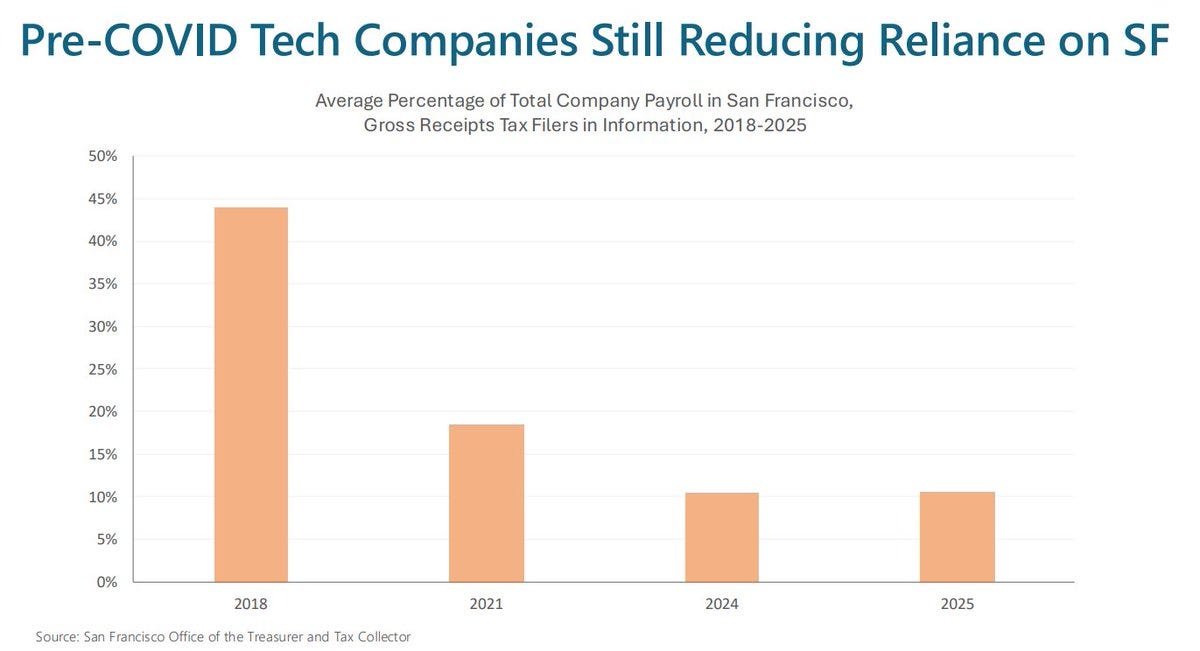
It is no coincidence that distributed work affects San Francisco more acutely than perhaps any other city. AI turbocharges this trend by making companies more eager to hire across more locations to access and match the best, most specialized talent for their purposes. Yes, some employers can pay enough to pull people from anywhere to San Francisco. But most employers and most roles don't offer enough, so the next best alternative is to split the team across multiple locations.
San Francisco is also at the forefront of another trend affecting offices and workplaces: companies can grow faster than their headcount.
Scalable Talent
It is easy to notice when people are getting fired and jobs are eliminated. It is harder to see the jobs that should exist but don’t. At some point over the past few years, something changed in the relationship between business growth and employment growth.
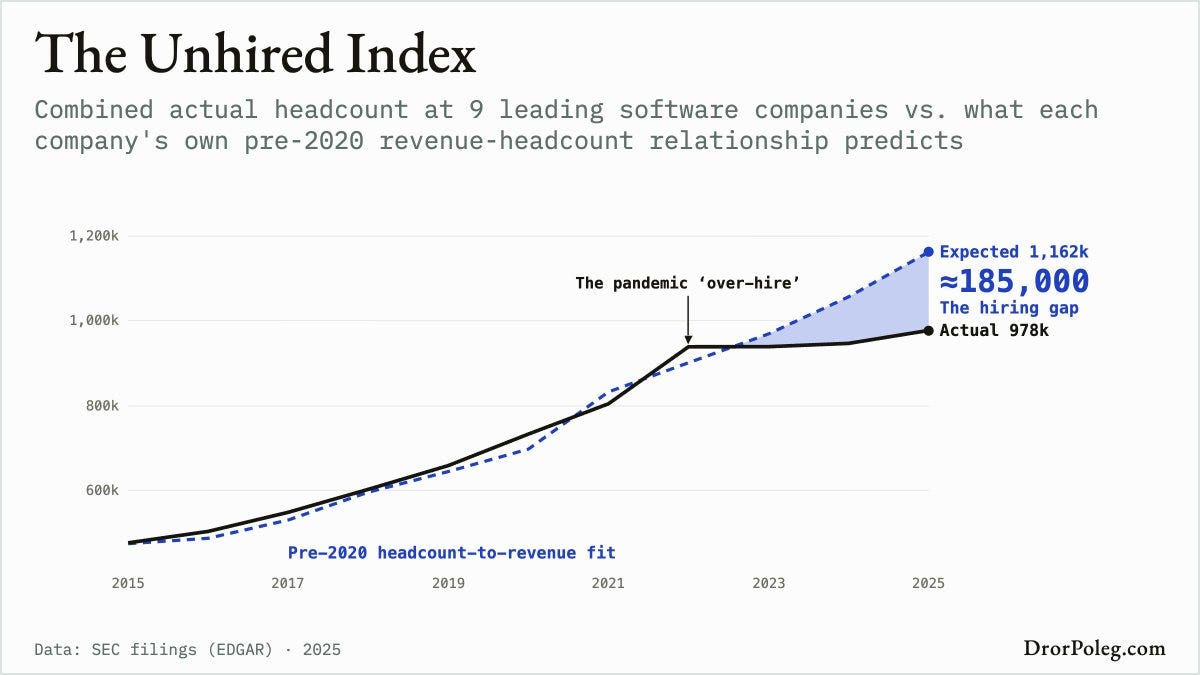
The chart below shows the relationship between revenue and employment growth in nine leading software companies1. Up until COVID, business growth meant headcount growth: if the company generated more sales, it employed more people. During COVID, employment outpaced revenue growth. This is the famous “over-hiring” era that preceded Elon Musk’s slashing of Twitter’s workforce in late 2022 and Mark Zuckerberg’s “Year of Efficiency” in 2023.
From 2023 onward, tech revenue continues to rise, but headcount barely budges. The companies kept growing and even accelerated, but they did so with far fewer employees than the previous hiring pattern would have predicted. Essentially, these software companies currently employ nearly 200,000 fewer people than they would have under the previous hiring regime.
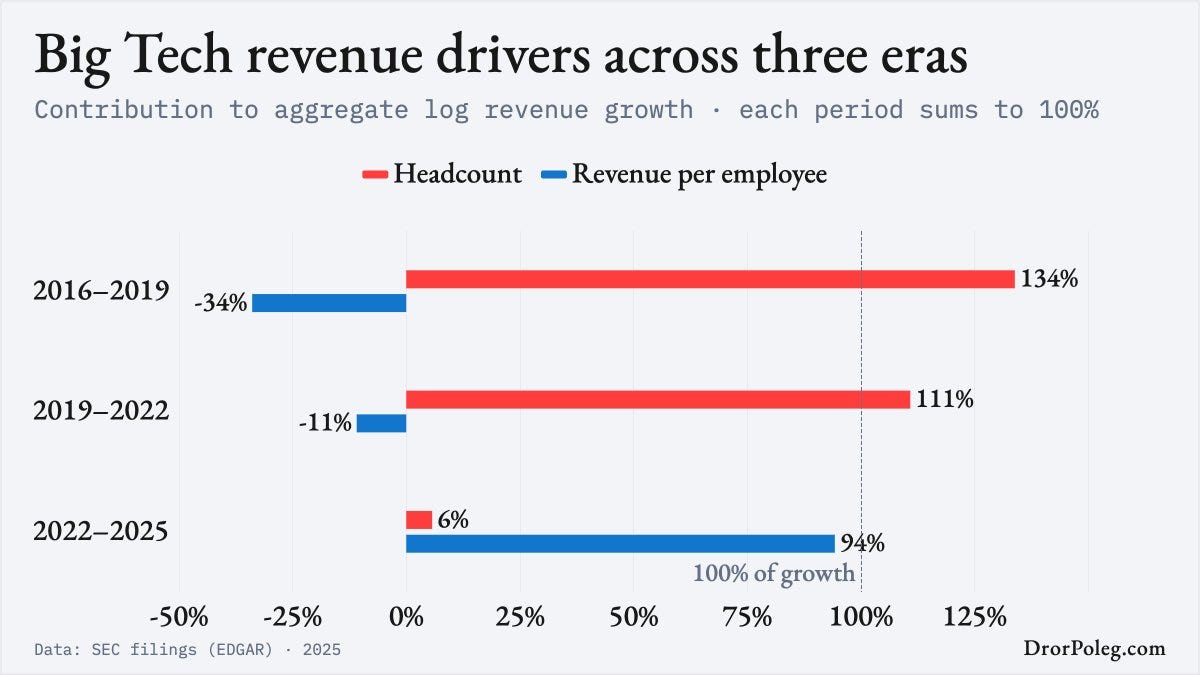
Another way to look at the same story is to break down what drove Big Tech’s revenue growth across three eras: pre-COVID, COVID, and post-COVID. In the first two, headcount grew faster than revenue, so revenue per employee actually fell, and more sharply before COVID than during it. In the third era, the pattern flipped: nearly all revenue growth came from higher revenue per employee, and almost none from adding people.
Why is this happening? The most popular answer I’ve heard is that the post-COVID hiring slowdown and Big Tech layoffs are a result of the massive over-hiring during COVID. Under this theory, companies were too optimistic about the future, hired too many people, and then had to lay them off when future growth didn't materialize.
There are three issues with this theory:
COVID “over-hiring” was limited, and it was corrected quickly: As you can see in “The Unhired Index” above, the small blip of “over-hiring” in 2021 and 2022 was corrected by a similar-magnitude blip of under-hiring in 2023 and 2024. The growing gap between revenue and employment is much larger than any prior over-hiring.
Pre-COVID “over-hiring” was more significant: As you can see in the “Big Tech revenue” chart above, companies compressed their revenue per employee more intensively between 2016 and 2019. That meant they were growing headcount faster than revenue well before COVID. They continued to do so during the COVID years, but to a lesser extent.
Growth continued after hiring slowed: Revenue kept rising even as headcount flattened. Companies originally hired because they expected growth and the growth actually arrived. It just didn't require the labor.
If companies kept growing, why did they stop growing headcount?
My read is that AI played a role, but much of its initial effect was indirect.
The threat of AI disruption helped push tech companies to act on productivity improvements that happened over the previous decade. Just as lockdowns made companies realize a lot of work could be done remotely, the sudden vibe shift from CEOs like Musk and Zuck, and the specter of AI’s impact made companies realize a lot of work doesn't have to be done at all.
The possibility of growth without greater office demand was already visible before COVID. As I wrote in 2019:
“Technological innovation might lead to dramatic growth in economic activity and corporate profits while simultaneously reducing overall demand for office space.”
Companies kept hiring at pre-COVID levels partly because they didn’t have a better idea. They assumed they needed that many people, and were scared that cutting headcount would affect growth. The launch of ChatGPT threatened the search, cloud, and content businesses of all big tech companies. It forced them to focus and optimize their spending.
This optimization meant funneling billions into new data centers and AI projects rather than new hiring. For every dollar of revenue they brought in, the biggest software companies employed fewer people and spent much more on new construction and equipment.
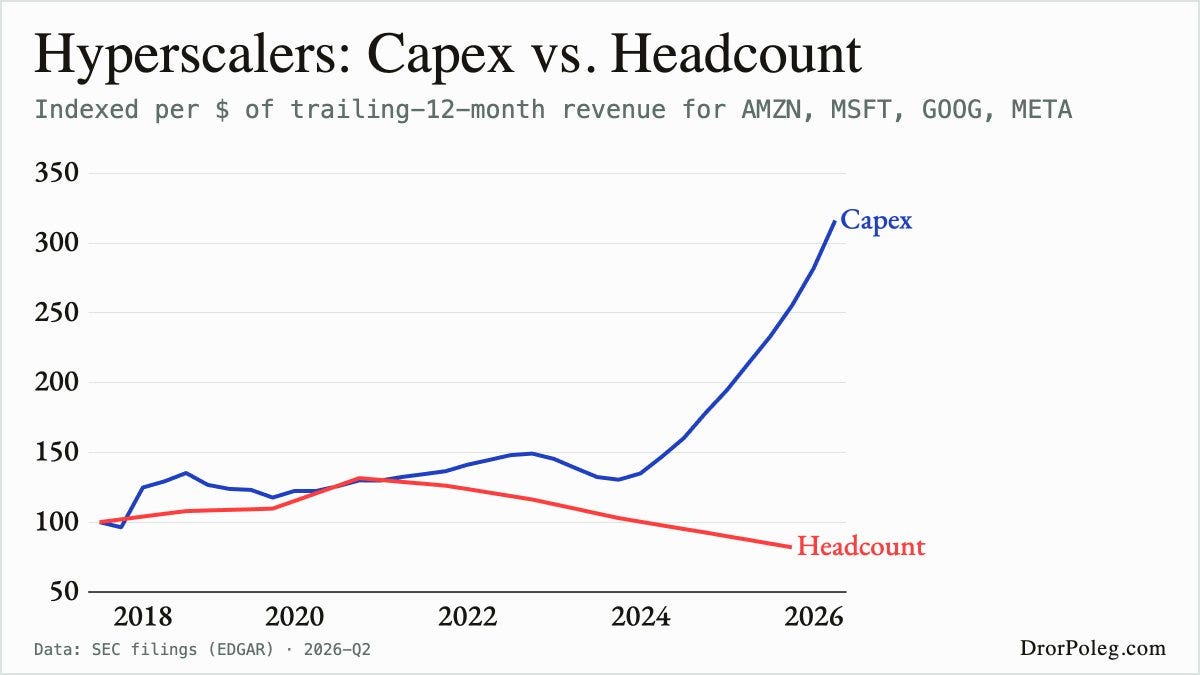
AI can reduce hiring before it automates anyone’s job: investment in computing competes with investment in people. Did AI also let companies do more with fewer people?
It started to. In 2024, I pointed out in The Atlantic that a new breed of software companies can generate significantly more revenue with far fewer employees than the big tech companies:
“Artificial-intelligence advances may reduce the number of office jobs and improve the quality of remote collaboration. Data from the epicenter of the AI revolution offers a preview. In 2003, the year in which Google first passed the $1 billion revenue mark, the company employed some 1,600 people. Last year, OpenAI required less than half that number of workers to exceed the same milestone.”
Today, OpenAI and Anthropic are no longer tiny companies. Their combined annualized revenue run rate now exceeds $100 billion, and each of them employs thousands of people. Are they still employing fewer people per unit of revenue? Yes, even more so than in 2024. As you can see below, frontier AI labs generate about three times as much revenue per employee as Meta and Alphabet2. And these last two are already two of the most formidable companies that ever existed.
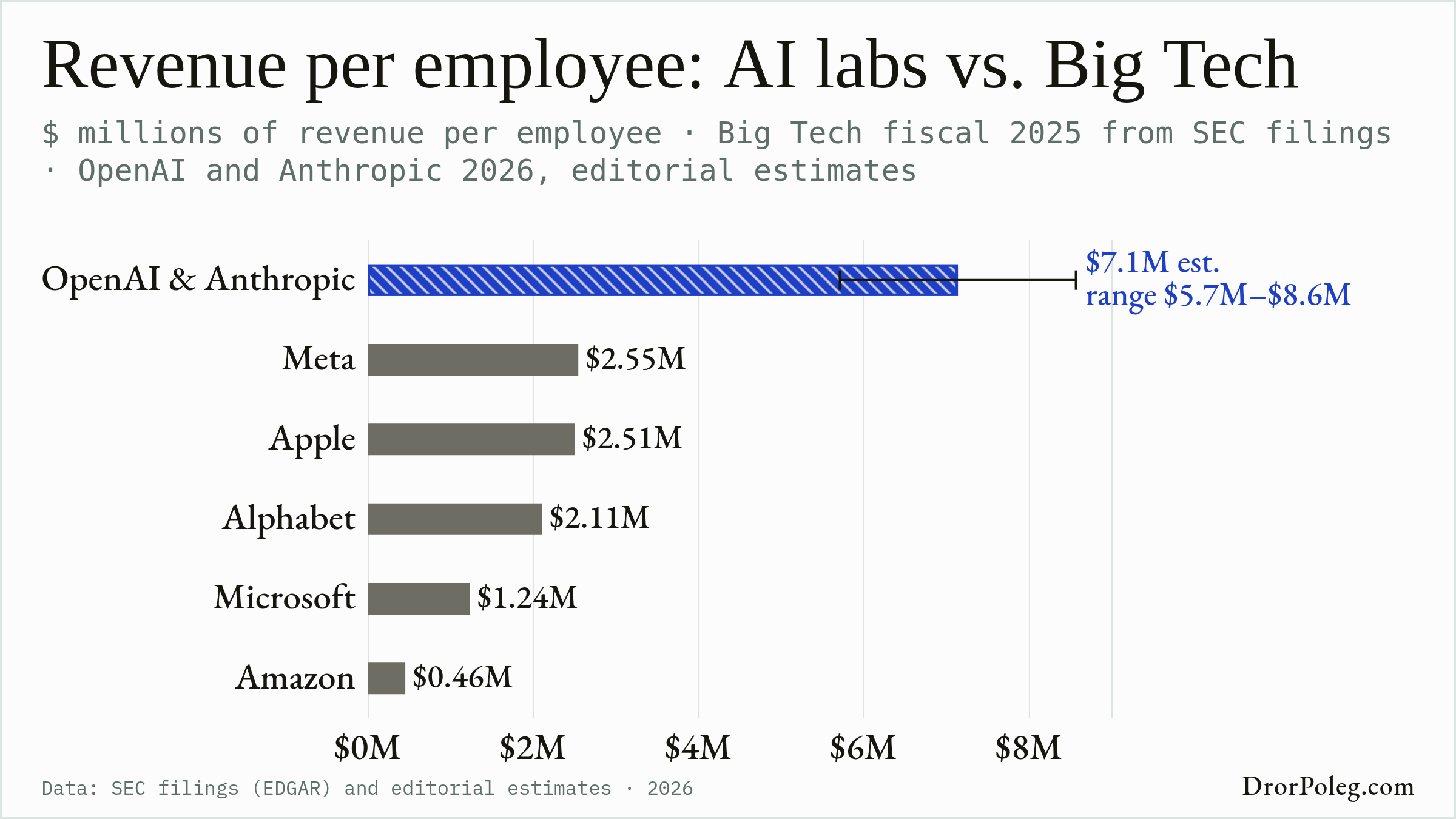
These companies show how much revenue a business can generate with a relatively small workforce. Their revenue per employee does not, by itself, tell us how much of that advantage comes from using AI internally. But if other companies achieve similar gains, business growth could generate much less hiring than it once did. How far and how fast that spreads is anyone's guess.
Which brings us to the final trend eating the office.
Uncertain Production
An office lease is a forecast. When a company signs a ten-year lease, it is predicting how many people it will employ, where they’ll live, what they’ll do, and how often they’ll need to be in the same room for the next decade. That made sense when more revenue reliably meant more people. Today, it’s a guess. Few CEOs could describe their 2028 org chart with a straight face. So they commit to less, for shorter periods, and keep their options open.
Over the past few decades, our economy has become nonlinear. Most of the value it produces now comes from intangible things: software, content, brands, networks, data, and expectations.
Intangible value follows different rules. Traditionally, when you made cars or built office towers, inputs and outputs moved together: twice the steel and labor yielded roughly twice the output. When you make software or content, that link breaks. The same inputs can produce wildly different results. A small tweak can turn a flop into a hit, and success compounds in ways no one can plan. We’ve already seen one version of this above: before 2020, Big Tech’s revenue and headcount moved in lockstep. Then they came apart.
We are still producing plenty of physical things like buildings and machines and barrels of oil. But even the value and utility of these things are now governed by the nonlinear dynamics of intangible production. A car is increasingly worth what its software can do. A hotel is worth what its brand and booking algorithms can fill. Memes move markets.
The clearest case is the data center. It’s about as physical as an asset gets: concrete, steel, copper, cooling, and power. Yet over the past few years, it has been built at the speed of software. Worldwide, data center spending is on track to top $1 trillion this year. In the US, construction spending on data centers multiplied in two years. The Census Bureau counts data centers as a type of office, and they’re now the bigger part of the category: America spends more building offices for chips than offices for people. This wave of investment has swept up America’s capital as fast as a viral video sweeps up its attention.
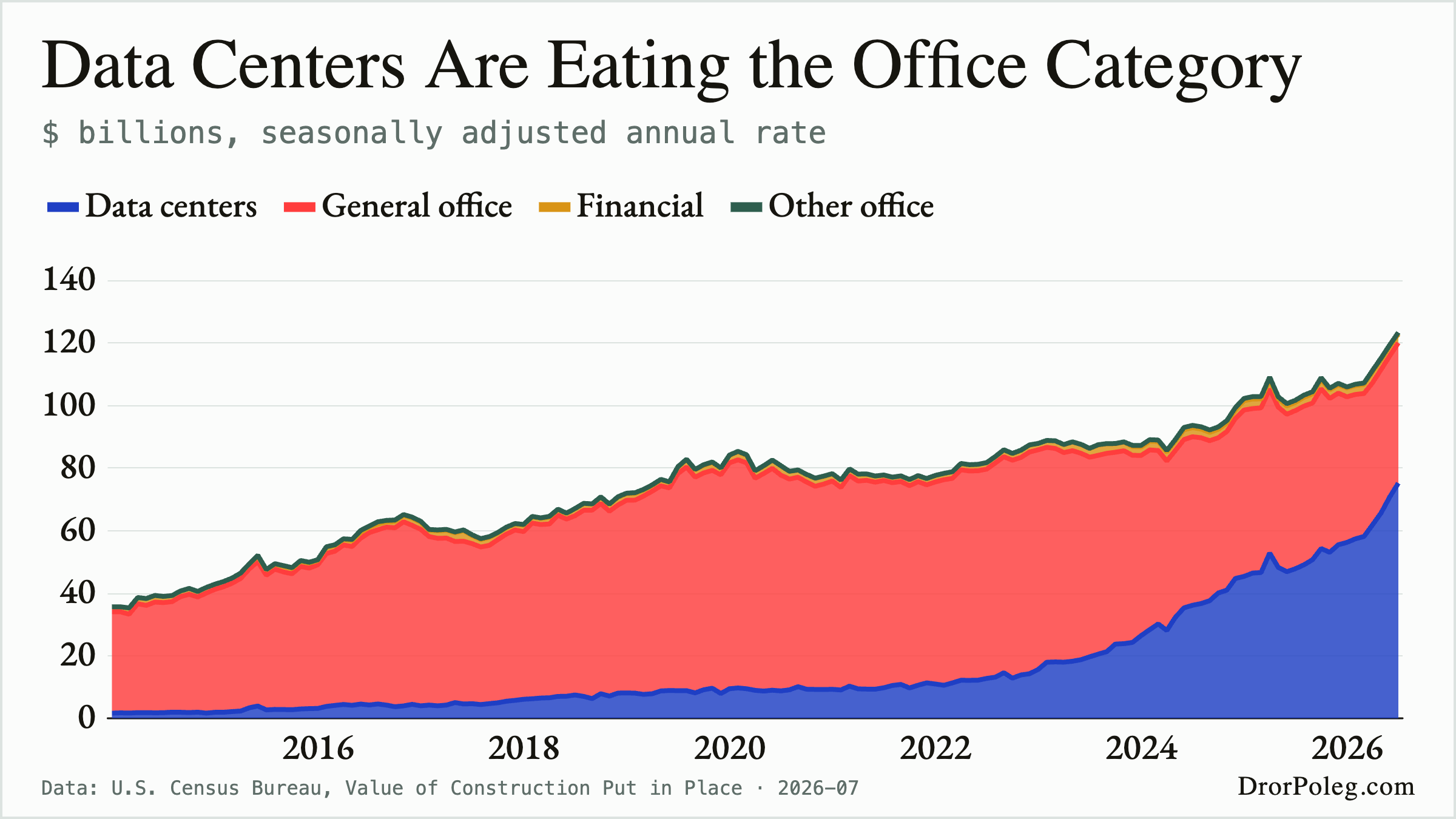
And just like a viral video, the data center’s enduring value is also inherently uncertain. All that concrete and copper is a bet on what AI models will be able to do, how they will operate, and how much computing and energy they will require.
And yet, even the people developing these models can’t fully answer these questions. They can’t always predict what their own models will do. This spring, OpenAI had to explain why ChatGPT kept talking about goblins. The culprit was a reward signal in one personality setting that touched 2.5% of responses, produced two-thirds of the goblins, and then spread to the rest of the model. Nobody designed it, and it took months to figure out. And frontier AI is no longer at the frontier; it is already at the core of our economy. As I wrote in May:
“Our GDP growth, stock markets, and job growth are overwhelmingly dependent on data center construction. Data center construction is dependent on the capital expenditures of five companies. The spending decisions of those five companies depend on the performance of two startups. The performance of these two startups depends on a handful of researchers. And those researchers do not fully understand what they are doing.”
Much of the economy has become one concentrated bet on the future of LLMs. If the people at the top of the chain can’t forecast their own products, everyone downstream has an even harder job. AI makes production more uncertain in three ways.
First, competition gets faster. An advantage built on software can now be copied or leapfrogged in months. Products, business models, and entire categories rise and fall faster than before. The same goes for the people who build them. The result is a paradox I described shortly after ChatGPT launched:
“Tech skills will continue to be in high demand. But tech jobs will become less safe… When everyone can build software, many average or less creative programmers will suddenly face intense competition.”
Second, humans get pushed up the ladder. AI takes over the work that was already structured: drafting, coding, summarizing, analyzing. In developed economies, that pushes people toward the work that can’t be written down in advance. Deciding what to build. Figuring out what the customer actually meant. Knowing whom to trust.
Unstructured work is also harder to staff in advance. That’s the logic behind Jobs’ “clusters of people” and Pranav’s description of OpenAI. When you don’t know what next quarter’s urgent problem will be, you don’t build a department for it. You assemble a team, and dissolve it when the job is done.
Third, capital follows the bet. As we saw above, the biggest companies are pouring money into data centers rather than people. So every other budget line, from headcount to real estate, now sits downstream of a wager with an unknown payoff. And when your biggest expense is a wager, you keep everything else flexible.
The Interaction Between The Elements
The debate over what’s eating the office is usually framed as a contest between causes. But these forces aren’t separate. They feed each other. Once work can be coordinated across locations, companies can recruit more widely and reorganize teams more easily. If those teams also generate more revenue per person, business growth requires fewer additional desks.
Meanwhile, faster competition makes future staffing needs harder to predict, increasing the appeal of flexible arrangements. These changes affect both how much space companies need and where they need it. Distributing a team can shift demand between cities; increasing revenue per employee can reduce the space required for a given amount of business activity.
What about interest rates? One popular view holds that the office slump is mostly a story about money: when rates jumped in 2022, cheap capital disappeared, and with it the appetite to hire and expand. Rates certainly mattered. But they didn’t stop the biggest companies from spending. The same firms that froze headcount poured record sums into data centers. They didn’t lack capital. They chose chips over people.
Where rates did bite is on the supply side. Higher financing costs, combined with weak demand, have all but halted new office construction. JLL reports the least office space under development in more than 30 years of tracking. Cushman & Wakefield puts deliveries at a 14-year low, with the construction pipeline at less than 30% of its long-term norm, and total office inventory has shrunk by about 33 million square feet over the past five quarters. Meanwhile, the pipeline of office-to-apartment conversions has roughly quadrupled since 2022.
Conclusion
Where does this leave us? All of these forces are likely to intensify. Distributed work will keep spreading, because AI makes it easier to find and coordinate specialized talent wherever it lives. Companies can grow revenue without a corresponding increase in headcount, even before AI directly replaces employees. And uncertainty will grow, because the technology behind all of this keeps surprising the people who build it.
And yet occupancy may well improve. Not necessarily because workers return, but because the supply of offices is finally shrinking. Almost nothing new is being built, and the least competitive buildings are being converted or taken off the market. A market can look healthier simply by getting smaller.
But the real story isn’t about quantity. It’s about kind. Look at what tenants are actually signing. In the first quarter of 2026, US companies signed more office leases than in any quarter in a decade, according to CoStar. But new leases have been about 15% smaller than pre-pandemic averages since early 2023. Demand didn’t disappear. It fragmented into more, smaller leases.
AI may ultimately create more human work than it eliminates. But more work will not necessarily produce the same demand for offices. What matters is how many people do that work, where they do it, and how confidently their employers can plan ahead.
Most of today’s office stock was built for a linear company. One that grew by adding people, kept them in one place, and could predict what it would need ten years out. That company is getting rarer. The companies taking its place are nonlinear: They grow much faster than their headcount, spread teams across cities, and reorganize around whatever is urgent this quarter.
Nonlinear companies still need places to meet, think, and build trust. What they don’t need is to forecast all of it on a ten-year lease. They need something closer to a network of spaces and services: space that can be added, subtracted, and moved as fast as the org chart changes.
Free Event: Thinking About AI, with AI
In October, I'll give a free online talk about how I use AI in my own work, and how I think about AI’s impact on everyone else’s work. It will be a live demo of some tools I use and tools I’ve built, plus some data points and dynamics I am tracking.
You can sign up for free here.
I was invited to give this talk by my online friends Eleanor and Hugo. They are launching a course on how to use AI agents to build tools and products for yourself and others. You can learn more about the course here — my subscribers get a 25% discount, but only with this link.
I excluded Amazon from the original 10 since most of its employees are in warehouses and trucks. See full methodology here.
OpenAI and Anthropic file nothing, so their revenue and headcount are estimates, as follows: about 8,000 OpenAI employees, the company’s stated plan for the end of 2026, plus just under 6,000 at Anthropic, a third-party estimate from Revelio Labs, against a combined revenue run-rate of roughly $100 billion, my reading of both companies’ reported figures. That gives about $7.1 million per employee; a run-rate between $80 and $120 billion gives $5.7 to $8.6 million. It is one pooled figure, not each company’s. Once one of these companies files its S-1, we will have more precise figures.