


I sat down with Jacob Shapiro on his podcast to talk about AI, the nonlinear economy, the future of work, China, cities, and the war in the Middle East — you can find the full conversation on Spotify, Apple Podcasts, YouTube, and other platforms.
The conversation ranged widely. Below are some thoughts on two related themes we discussed: What AI actually is and what it actually wants.
AI is a Medium, Not a Tool
Most of the conversation about artificial intelligence is stuck on the wrong question. We ask whether AI will replace this job or that job, whether it will make us more productive, and whether it will sit obediently on our desktops or run around performing things independently at our bidding. That framing assumes AI is a tool.
It isn’t. AI is a medium. And once you see that, the entire shape of the economy it’s producing snaps into focus.
A tool extends what you do. A medium packages what you are. The phonograph didn’t help singers sing; it took their performance, contained it, and broadcast it to a million people in parallel. Recorded music didn’t expand the number of singers in the world. It collapsed their income distribution into something violently unequal: a handful of stars, an ocean of baristas with guitars. The number of singers stayed roughly constant. What the technology dictated was a different income distribution, a different level of job security, and a different path toward success.
AI does the same thing, but for everything. As I told Jacob,
“AI can take me, my personality, my thinking, my ideas, and then serve a million people in parallel in the same way that a recording serves a million people in parallel, but in a much richer way, so they can actually interact with me rather than just listen to something that I did.”
This is why the “will AI replace my job?” question is a distraction. The more honest question is: how will AI change the income distribution of the game I’m playing, regardless of whether I’m a winner or a loser in it? Singers weren’t replaced by recordings. They were re-sorted. So were authors after the printing press, actors after film, photographers after the iPhone. The technology didn’t fire people. It changed who got paid, and how much, and how stable that pay was.
AI Doesn’t Want to Replace You. It Wants to Make You Interchangeable.
Here is the line that should sit on the desk of every white-collar professional in the world:
“The goal of capital is not to replace you because capital doesn’t want you to go on vacation. The goal of capital is to make you interchangeable, not to replace you.”
The history of work is a history of this drive. The artisan becomes the production-line worker. The creative becomes an office worker on a different kind of production line. The freelancer becomes a profile on a matching platform — Uber, Upwork, whatever — where if the client doesn’t like you, there are twenty others one click away. Each step preserves the work and dissolves the worker’s leverage.
Hollywood is the cleanest illustration. Early studios refused to print actors’ names on posters, a deliberate strategy to keep talent fungible. Once performers like Florence Lawrence and Mary Pickford became recognizable to audiences, their names became assets. Suddenly, actresses had pricing power. The studios paid up because stars made movies more likely to succeed. But as soon as they paid up, studio bosses started searching for ways to drive labor’s pricing power back down. The logical conclusion is what we have now: Marvel, Disney, and DC Comics, where the IP is the star and the actors playing Spider-Man or Wonder Woman are replaceable. The value sits in the asset, not the person.
AI is a machine that turns labor into capital — people’s work into work that can be done by computers and electricity. The goal of capital is to turn labor into a commodity. This is not a critique of capitalism; it’s just an observation of the inherent tendencies that drive our economy forward.
The good news is that capital can never fully succeed. Every time our economy figures out how to automate a profession or make certain skills interchangeable, humans come up with new things that other people want and cannot be described or measured well enough for a machine to do.
The other good news is that capital is not an independent entity. It is owned by people. So the question is not how to stop it from growing; it is how to spread it in a way that makes life better. The answer is not as simple as our politicians think.
More on this, soon!
On the podcast, Jacob and I covered a lot more than AI: the nonlinear economy and why all swans are now black, what’s happening to cities, why China’s volatility-suppression model has an expiration date, why the politics of both left and right are selling 1950s answers to a 2020s economy, and what the war in the Middle East reveals about all of it.
I’ll be unpacking those threads in the coming weeks. In the meantime, you can listen to my conversation with Jacob Shapiro on Spotify, Apple Podcasts, YouTube, and other platforms.
Have a great week!
Best,

Psst, are you a workplace executive?
Next month, I will be in London for a workshop about the future of work and workplaces. It’s a very cool gathering, in a very cool spot, with very cool perks. Would you like to join us? The organizers are looking for senior leaders & executives leading corporate workplace strategy based in the UK & Europe. If this sounds like you, drop me a line.
How will AI reshape our cities, companies, and careers?
My speaking schedule for the year is filling up. Visit my speaker profile and get in touch to learn more.
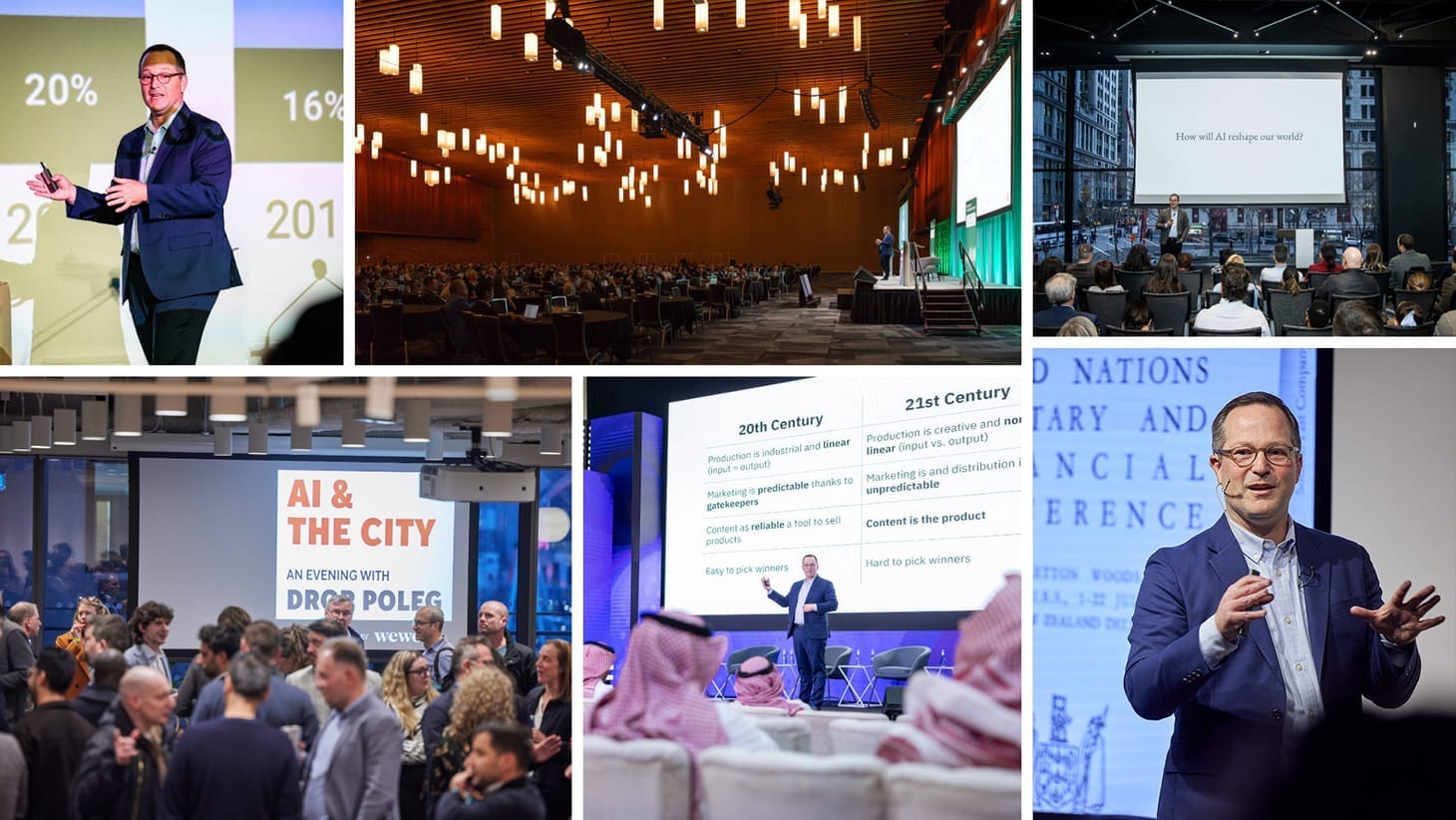
Click here to book a keynote or learn more.
No its not…its a tool for various workflows…a medium implies seamless integration and efficiency…in order for it to be a medium as far as entertainment the turn around time has to be faster…u looking at an hour for a minute clip from start to finish…the faces arent going to be identical even if u using the same prompt…coca cola struggled to do a minute ai commercial and that flopped because the faces didn't match…its good for information and automation…but its still has a long way to go to be used as a medium…I use it more than most ppl and hit walls…plus not everything has been put into llm..rare and vintage clothing as an example…old movie posters etc…its alot of things it cant do…and u will only realize that the more u use it….thats part of the reason why I dont get the hate…ppl hate it because it makes them feel dumb…not because of what it can do….remember all the excel spreadsheet jokes? Yeah those ppl now struggle with ai…