


My book deadline is 11 days away, but I wanted to share a new interview I recorded last week. I joined Steven Feldman for a wide-ranging conversation about AI, investing, drones, real estate, Warren Buffett, and why the whole economy increasingly behaves like show business.
Early in the conversation, I said something that probably explains too much about me:
Some people are scared of rolling off the bed when they sleep, so they try to sleep in the middle of the bed. I like to fall asleep holding the edge of the bed, because if I know where the edge is, I can sleep in peace.
So, what can be seen from the edge?
Watch our full conversation below. You can also find it on YouTube:
For those who prefer words to videos, I asked one of my robots to sum up three of the many themes Steven and I discussed.
1. The lesson of drones is not drones
Everyone is talking about drones — in Ukraine, in the Middle East, and in every defense ministry on earth. But I think many people are learning the wrong lesson.
They see cheap drones defeating or bypassing expensive military systems and conclude: “We need to build more drone factories.”
But that’s a linear lesson from a nonlinear phenomenon.
The real lesson is not that drones are important. The real lesson is that the software, tactics, supply chains, and teams behind them can evolve at the speed of software.
As I put it in the podcast:
“It’s not about the drone or the thing. It’s about the process that produced it.”
The point is not to predict which thing will matter next. Today it’s a drone. Tomorrow it may be something else entirely.
The point is to build an ecosystem that can experiment, adapt, manufacture, deploy, learn, and replace itself quickly.
I used a frivolous analogy in the conversation, but I think it makes the point. Looking at drones and deciding to build drone factories is like watching Gangnam Style go viral and concluding that Hollywood should spend a billion dollars making more videos of Korean men jumping.
That is not the lesson of TikTok.
The lesson of TikTok is that nobody knows what people want to watch. So the system enables endless experimentation, notices what gains traction, scales it quickly, and assumes that whatever works today will stop working soon.
That is a much better model for the world we’re entering.
2. The best systems assume they know very little
This is the deeper point.
The old world rewarded people and institutions that knew things: the right plan, the right forecast, the right product, the right career, the right five-year strategy.
The new world rewards systems that assume they know almost nothing.
Venture capital works this way. Hollywood works this way. TikTok works this way. Quant funds work this way. Increasingly, military systems work this way too.
They do not begin with certainty. They begin with uncertainty.
They make many bets. They expect most of them to fail. They scale the few that work. And they move on before the environment changes again.
This is also why so many people struggle to understand the current economy. We are still trained to believe that careful analysis should produce the correct answer. But in an increasing number of domains, the correct answer does not exist in advance. It has to emerge through experimentation.
That is true for war.
It is true for markets.
And it is becoming true for work.
3. You have already been automated
The scariest question about AI is: What happens when machines can do what humans do?
But in some sense, that already happened.
Most of the work people do today would have seemed unnecessary, absurd, or incomprehensible to someone living a century ago. Many of today’s jobs did not exist fifty years ago. A lot of modern white-collar work is made of meetings, coordination, persuasion, formatting, reporting, planning, signaling, compliance, and internal theater.
And yet, people are employed. They earn money. They create meaning. They invent new needs, new services, new status games, new forms of entertainment, and new ways to spend time and money.
That does not mean AI will be painless. It won’t.
It does not mean governments can ignore the social consequences. They can’t.
But it does mean that the question “Will there be enough work?” is not as simple as it seems.
Work is not a fixed pile of necessary tasks. It is something humans keep reinventing around the technologies, institutions, desires, fears, and absurdities of their time.
So yes, AI will automate many things.
But history has already automated us again and again. And each time, humans found new ways to be useful, or at least billable.
The challenge now is not simply to “save jobs.” It is to build an economy where more people can participate in experimentation — where more people have the tools, skills, capital, and freedom to try things that might matter.
In a world where nobody knows anything, we need more people making bets, not fewer.
That’s the optimistic case. Not that everything will be fine automatically. But that human usefulness does not come only from performing existing tasks. It also comes from discovering new ones.
In the full conversation, we also discussed why the economy increasingly behaves like show business, why intangible assets broke many old investing models, what Warren Buffett missed about Google, why AI is better understood as a medium than a tool, and why even real estate is becoming an operating business rather than a passive asset.
Watch the full conversation here. Have a great weekend.
Best,

How will AI reshape our cities, companies, and careers?
My speaking schedule for the year is filling up. Visit my speaker profile and get in touch to learn more.
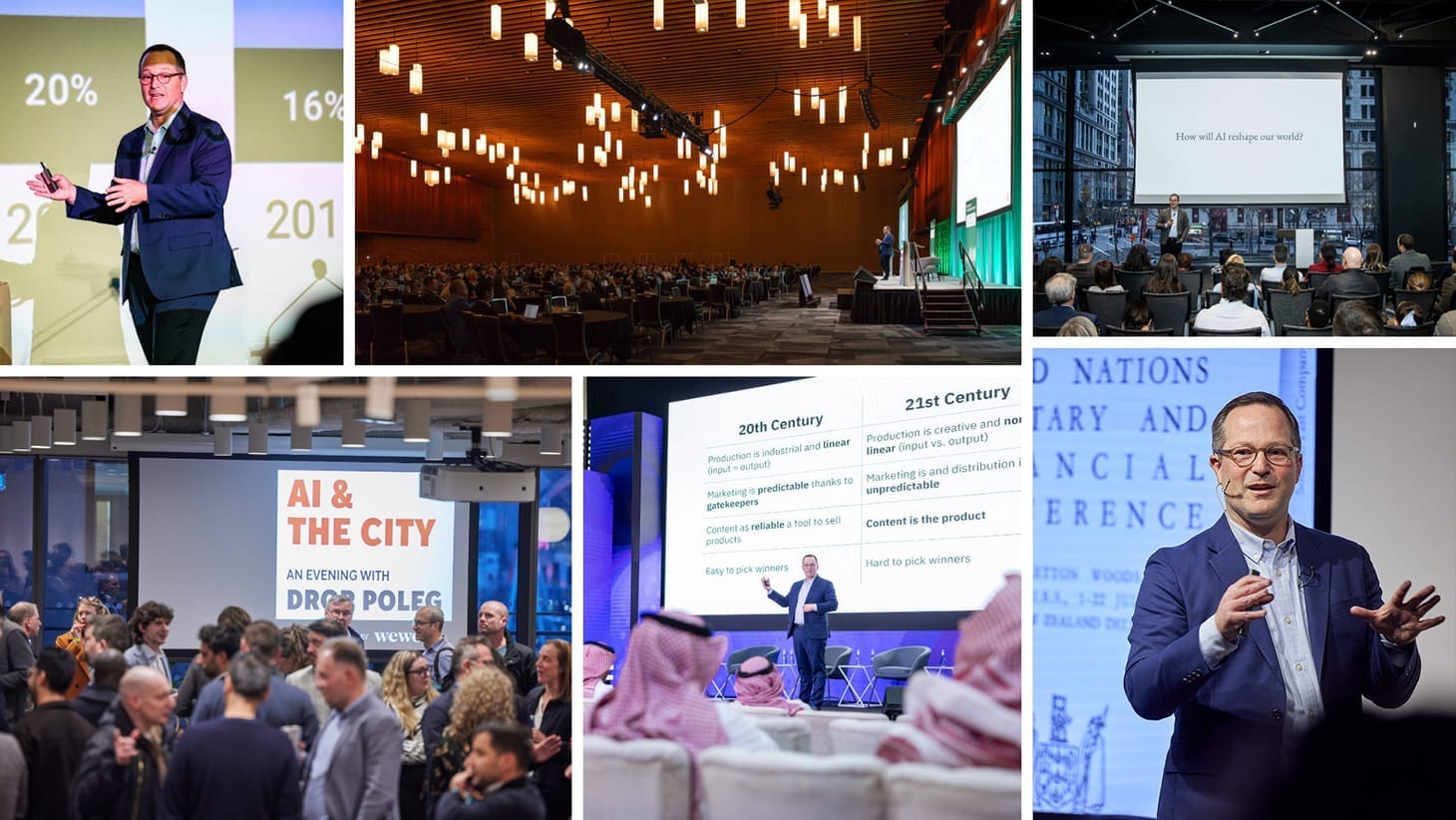
Click here to book a keynote or learn more.
In my humble opinion our public education systerm and our higher education institutions are not preparing their students for the non-linear economy you seeing. For example, conventional "school study" is a form of hypnotic conditioning. By forcing children to endlessly focus on pre-digested answers, schools condition them to seek approval from authority figures (teachers, examiners) rather than trusting their own observations.nTrue creativity, requires an unconditioned mind that is free to observe reality as it is. Because schools penalize mistakes and strictly reward adherence to a specific mold, they effectively paralyze a child’s natural creative impulse while replacing spontaneous curiosity with forced, rigid study schedules alienates children from their natural love of learning. It transforms education into a source of anxiety, stress, and mental exhaustion. Without reforms in education the next generations will not be equipped to succeed in the non-linear economy.
It's 100% Taleb reworded ...