

Your job can disappear before your employer notices. You’ll still get paid, go to meetings, and do your best. But the company will already be able to manage without you. This could continue for months, even years. Instead of being fired, you will be unfired: working in a job that is no longer needed, but hasn’t been eliminated yet.
The flip side of this is the unhired: Jobs that were supposed to exist but don’t. We can already see these in the data. As of the end of 2025, nine leading software companies employed about 185,000 fewer people than their own pre-2020 hiring pattern predicts. The Unhired Index tracks the gap between their actual headcount and what each company’s historical relationship between revenue and employment would imply.
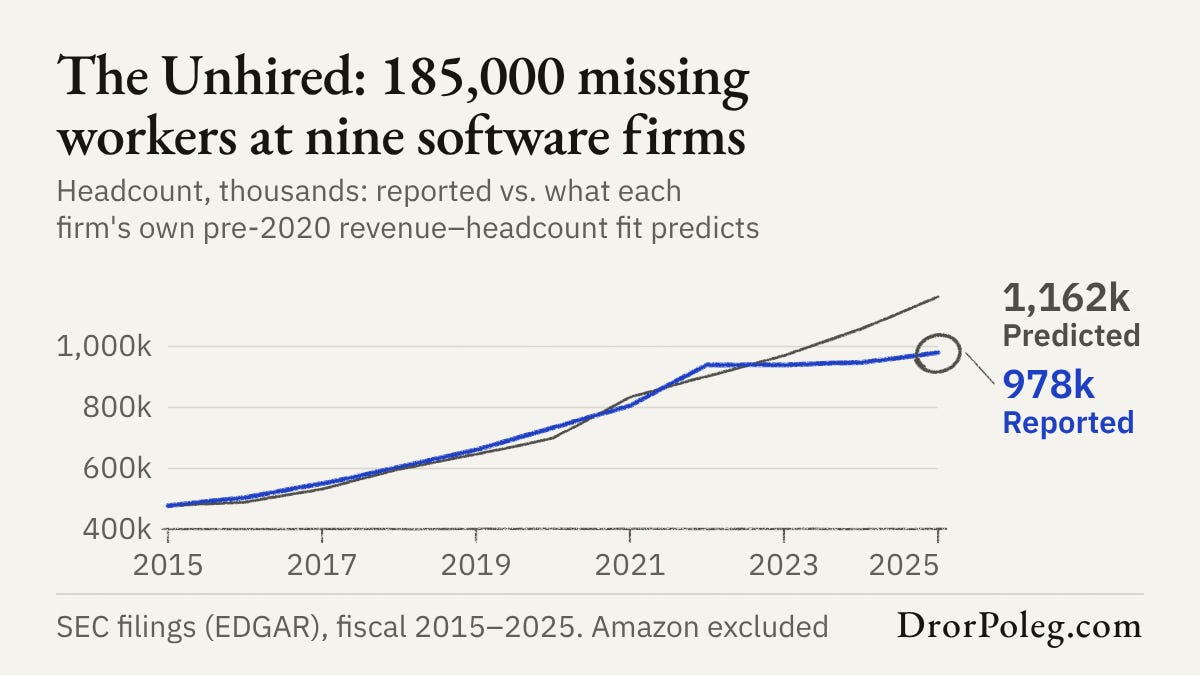
For a decade, revenue and employment growth moved together. In 2022, employment ran slightly ahead of revenue growth — a minor bout of “over-hiring” that was offset by the end of 2023. And then, by the end of 2025, these companies employed about 16 percent fewer people than the old relationship would have implied. 185,000 people who would have been employed under the previous hiring regime were left out. The business kept growing; the headcount, not so much.
Why did this happen?
Pent-up productivity
Economists are arguing about why. Goldman Sachs points to AI. John Burn-Murdoch recently examined the divergence in the Financial Times, linking to my Unhired Index. He found that it is overwhelmingly a US story, overwhelmingly a tech story, and that it began around 2022, before generative AI was widely deployed. As I also pointed out previously, rate hikes and uncertainty made companies pull back on hiring. Others point to the over-hiring of 2021 unwinding.
It’s important to look for explanations. A correction after a hiring binge has different implications from a technology that keeps improving. But another possibility is that companies are finally capturing productivity gains that have been available for years.
Every economic shock reveals the productivity gains of the era before it. Think of everything that happened before the chatbots arrived. Software ate its way through business processes. The cloud replaced server rooms. The pandemic forced companies to digitize whatever had resisted. Millions of people realized they could collaborate remotely, and some CEOs realized they could run their companies with far fewer middle managers.
But being able to work a certain way does not immediately lead to everyone doing so. When revenue is growing, budgets increase, and managers add people because there is actual work to do, and because adding people is how they have always dealt with more work.
Then an external shock forces everyone to reconsider the current arrangement. The shock could be negative (a pandemic, a financial crisis), positive (an incredible new technology that requires major investment), or both. Suddenly, instead of asking how many people the company can afford to add, management begins to ask how few it needs to keep. This is when the economy’s pent-up productivity is revealed: the gap between what technology makes possible and how organizations actually work.
Remote work illustrates this dynamic. In 2019, I wrote in my book:
“Office landlords are facing an unprecedented abundance of supply... it is the result of individuals’ ability—and desire—to work from anywhere.”
Most companies continued to organize work around the office. Then COVID forced them to use a capability that had been available for years. The change happened overnight.
Something similar is happening with AI. The hiring restraint that began in 2022 pushed companies to test how much they could produce with the people they already had. AI’s main impact on tech jobs is as a shock that forces companies to realize existing productivity gains. Over time, AI will generate more productivity gains of its own — but these will likely be revealed in full once another shock forces companies to embrace more radical change.
Growing with fewer people
Look at Meta. The company’s headcount peaked in 2022. Since then, its workforce has fallen by 9 percent while revenue has risen by 72 percent as of the end of 2025. The company’s margins improved, too.
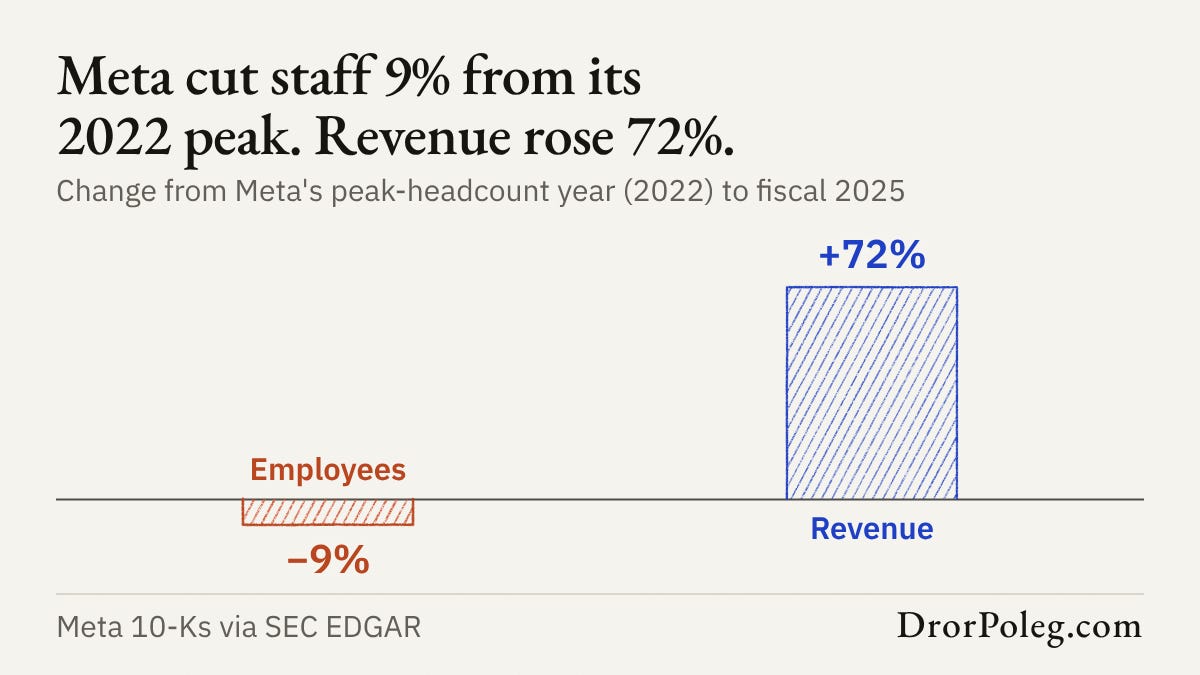
Those figures don’t show how much of the gap between revenue and headcount comes from better technology, better management, or changing market conditions. They do show that a much larger business can operate with fewer employees than it had before.
Mark Zuckerberg and Elon Musk were early to bet that a company could run with far fewer people. As I wrote about them in 2022:
The first-order effect of remote work is emptier offices. The second-order effect is leaner companies.
Once a few companies show there’s a new way to work, other companies take notice. Microsoft recently offered voluntary exit packages to as many as 60,000 employees, roughly 27 percent of its workforce.
These companies are not tightening their belts. They are spending heavily on expansion, while pulling back on labor. Over the four quarters through Q3 2026, capital spending by Amazon, Microsoft, Alphabet, Meta and Oracle amounted to about 10.7 million median American annual salaries.
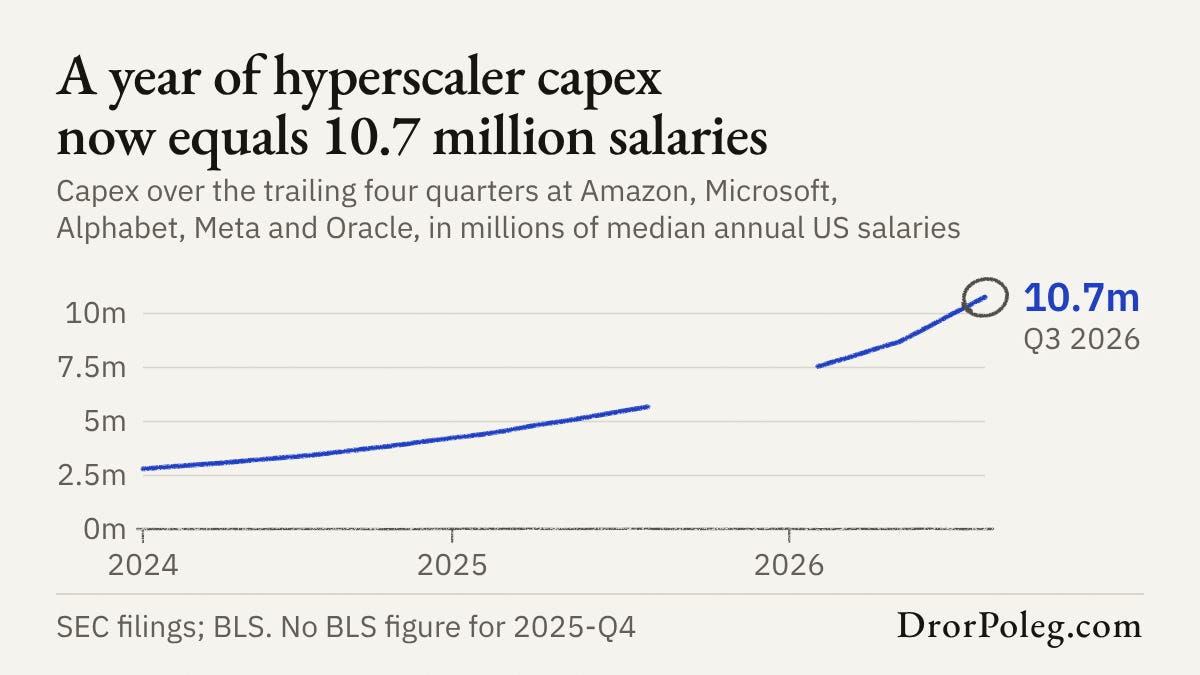
That is a comparison of scale, not a count of jobs displaced. Building and operating data centers supports at least some employment elsewhere. But the contrast is revealing. Working in a booming industry or successful company offers less reassurance than it once did.
Are you unhired or unfired?
If you are early in your career, being unhired is the more immediate risk: the opening that never appears, the team that no longer needs another junior employee.
If you already have a nice job inside a large organization, being unfired is the thing to worry about.
How can you tell whether you’re already unfired?
Ask yourself what would happen if you left tomorrow. Would your employer hire a replacement? Would the boss redistribute your tasks among your colleagues? Or would the tasks just stop getting done, and the company keep growing anyway?
The good news is that your company might take months or years to figure out your job is no longer necessary. You have an opportunity to figure it out first. Once you do, you can seek a new job that actually needs you, or help reshape your current job to make yourself truly indispensable. At least for a while.
Have a great weekend.
🎤 Planning a conference or leadership offsite? I speak about how AI is reshaping work, places, and markets—and what it means for your organization. Explore my keynote topics and get in touch.
📺 Did you see? I started posting short videos on YouTube, TikTok, and Instagram. Follow me there for a more casual perspective on the future of work, tech, and global events.
The unfired framing names a risk that a busy calendar can hide: being occupied isn't necessarily the same as building durable skills. For early-career people, the unhired risk also raises a practical question about how to build proof of work before someone gives you an opening. Does the Unhired Index show that gap closing anywhere, or only widening?