

There’s a lot of talk about AI’s impact on jobs, but what about its impact on whole companies? Specifically, how will it change the structure of organizations?
One way to think about these questions is to look at how companies interact with customers, and how technology changes these interactions over time.
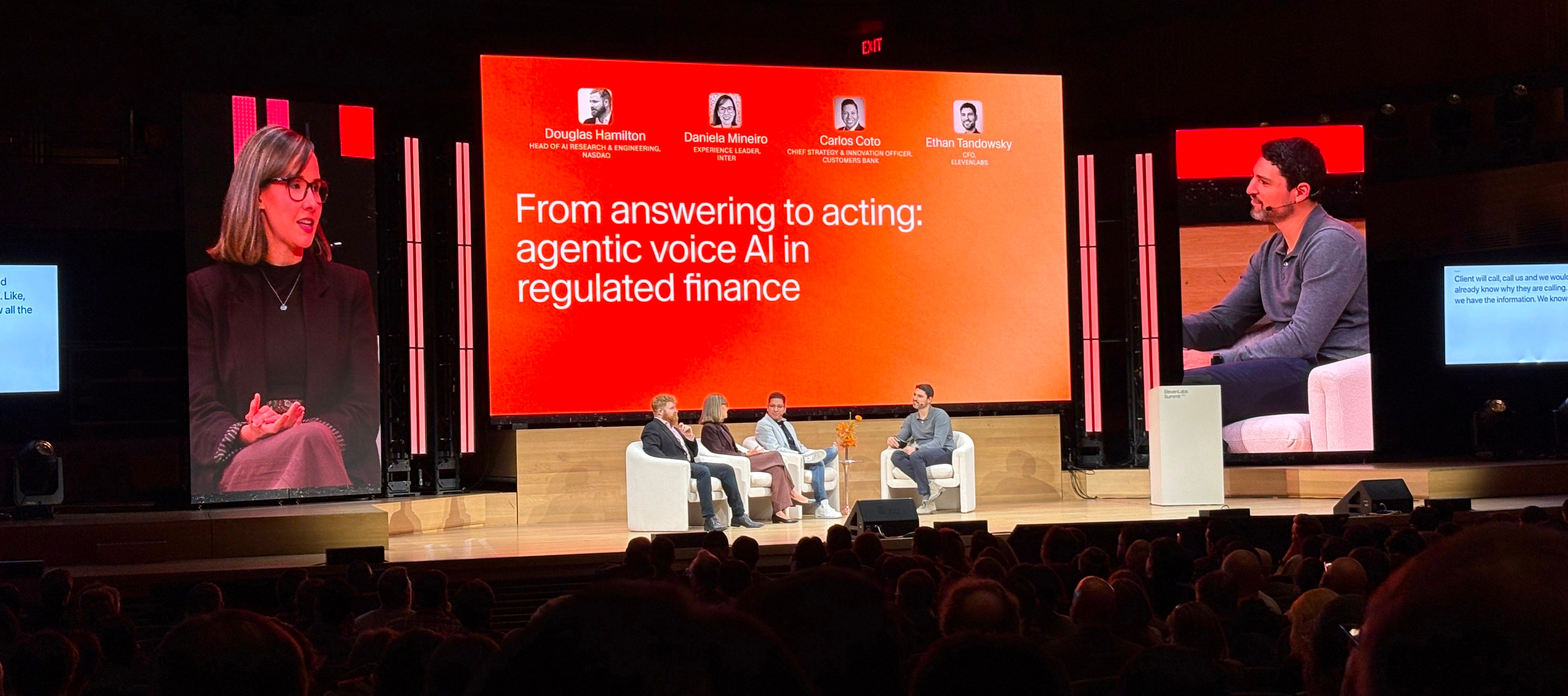
In early November, I went to ElevenLabs’ first New York City Summit. For those unfamiliar, ElevenLabs specializes in AI voice models. It was initially known for turning text into realistic-sounding human voices. These days, it focuses on voice agents that handle customer service, sales, training, and other tasks that require customers or employees to speak with an intelligent, well-informed agent.
One panelist was Daniela Mineiro, who oversees customer experience at Banco Inter, a Brazilian bank. Mineiro described how her company uses AI agents to speak directly to customers and provide different services. When asked how AI could help them do even more, she said her next goal is to shape the conversation with the bank around the customer’s needs rather than around the bank’s various services.
“Focus on the customer” is something all corporate executives say. But something specific about Mineiro’s approach made me think about AI’s broader implications. When a customer interacts with a large organization, the conversation is shaped more by the org chart than by the customer’s needs. We all know the feeling: One person answers the phone, then transfers us to another, then we need to speak with yet another to handle a different issue, and so on.
There are good reasons for this: Each person we speak to knows a specific product or service line, is trained to solve a distinct set of problems (technical, billing, legal, sales), has access to different systems, and follows different compliance requirements. But these reasons do not make the experience better. For the customer, the experience can be time-consuming, confusing, and frustrating. From the organization's perspective, this experience is logical and perhaps even unavoidable.
The fragmented experience reflects the organization’s fragmented nature. Fundamentally, it also reflects the limitations of human employees: no single person can be an expert in all products and fields, access all systems, have all relevant skills, and handle compliance for all types of regulations. The organization was shaped by the fact that no single person can access and process all relevant information on their own.
But an AI agent can. An AI agent can potentially access information across different systems, draw on expertise in multiple fields, remember relevant details, and operate across functions that previously required multiple specialized employees. Thus, an AI agent can theoretically provide the holistic, customer-centered experience Mineiro was talking about; it can deliver what the customer needs rather than give the customer a list of possible services and extensions based on how the company’s product lines and departments are structured.
Behind the scenes, the AI agent might still have to pull data from different departments, handle different data sets to meet compliance requirements, and escalate some requests to human reviewers. But from the customer’s perspective, the experience can be more pleasant and more effective.
Customer service is often seen as the canary in the coal mine—a subset of white-collar work that was early to get outsourced and offshored, and is now early to be impacted by artificial intelligence. But customer service is also a precursor to a much broader change: It can signal that the limitations that shaped the whole company are becoming less relevant.
An AI agent might serve customers across multiple departments while leaving the departments themselves intact. But its ability to do so raises a question: If the limitations that made these divisions necessary are eroding, what does that imply about the organization itself?
Here’s a useful exercise for executives trying to understand how AI can and will reshape their organization: Start by imagining how AI could transform your customer interactions. What could you offer if you were no longer constrained by existing departments, job descriptions, and reporting lines?
Then turn the question around: What would such an experience imply about the organization behind it? Which divisions would still be necessary, and which exist primarily to accommodate limitations that technology is beginning to overcome?
I’d love to hear what this means for your company and industry; just hit reply. You can also book a 60-minute executive briefing to discuss these questions with me directly.
Have a great week.
🎤 Planning a conference or leadership offsite? I speak about how AI is reshaping work, places, and markets—and what it means for your organization. Explore my keynote topics and get in touch.
📺 Did you see? I started posting short videos on YouTube, TikTok, and Instagram. Follow me there for a more casual perspective on the future of work, tech, and global events.
Or maybe why would anyone have one? I'm just watching what my friends and contacts are doing. My Lawyer/CPA/RIA all reducing and planning to reduce further support staff and juniors because they are integrating AI/agents into their workflow. I don't see how that ends well because humans can't outrun the machines. Hope I'm wrong about this and it's not a case of what makes sense at the individual business level is folly at the collective level?
This is already happening inside the organization. When one engineering group maintains an internal service and provides a dashboard to interact with that service a limited number of people are given permission to access the dashboard. Now, the service is accessible via an mcp server and anyone with an agent in the company becomes a customer.