

Every day, I highlight a few meaningful items. These could be articles, tweets, academic studies, data points, or quotes from books I read.
I built a system that helps me keep track of all these things, and I publish them on my website on a daily basis. I call them Signals, since they represent little bits of information that might tell us something meaningful about what happens next.
Earlier this week, I gave an open talk about the state of the AI economy, and about how I use AI for my own research, the tools I use, and the system I build for my own research. I included the videos of both parts at the bottom of this email. But first, I wanted to share some of this week’s signals with you.
Below is an experiment. I wrote and selected all the items. My AI system helped me find them, organize them, and generate simplified versions of the accompanying charts and data.
Please let me know if you find it valuable. Should I send one of these weekly, separately from any opinion or analysis pieces?
Work
Small businesses using AI expect to hire more, not fewer. In a late-2025 survey, AI users had “a 33 percentage point net expectation of higher employment,” non-users “only a 15 percentage point net expectation.” [Liberty Street Economics (NY Fed)]
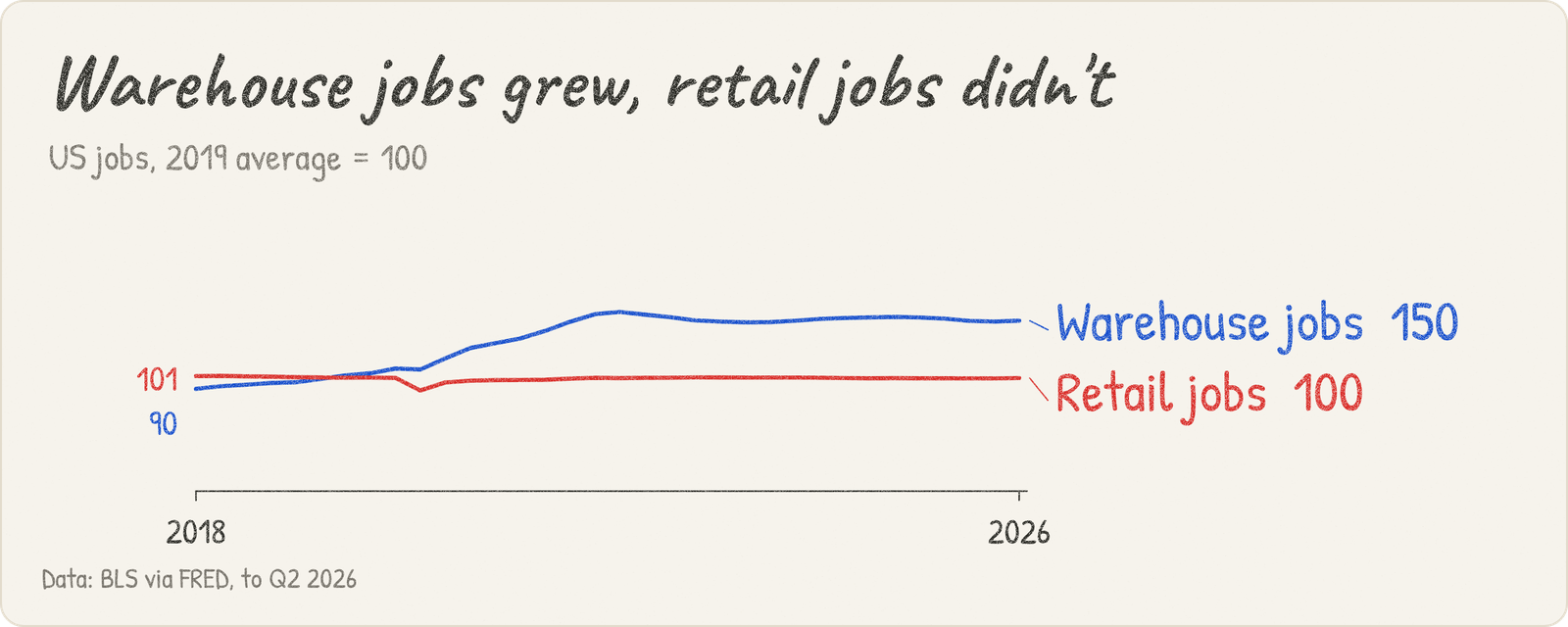
Since 2019, warehouse jobs are up 50% while retail jobs are flat. Data centers and offices may follow a similar path, with two differences: data centers need far fewer people than warehouses, and office jobs will likely decline rather than just stay flat. [my chart]
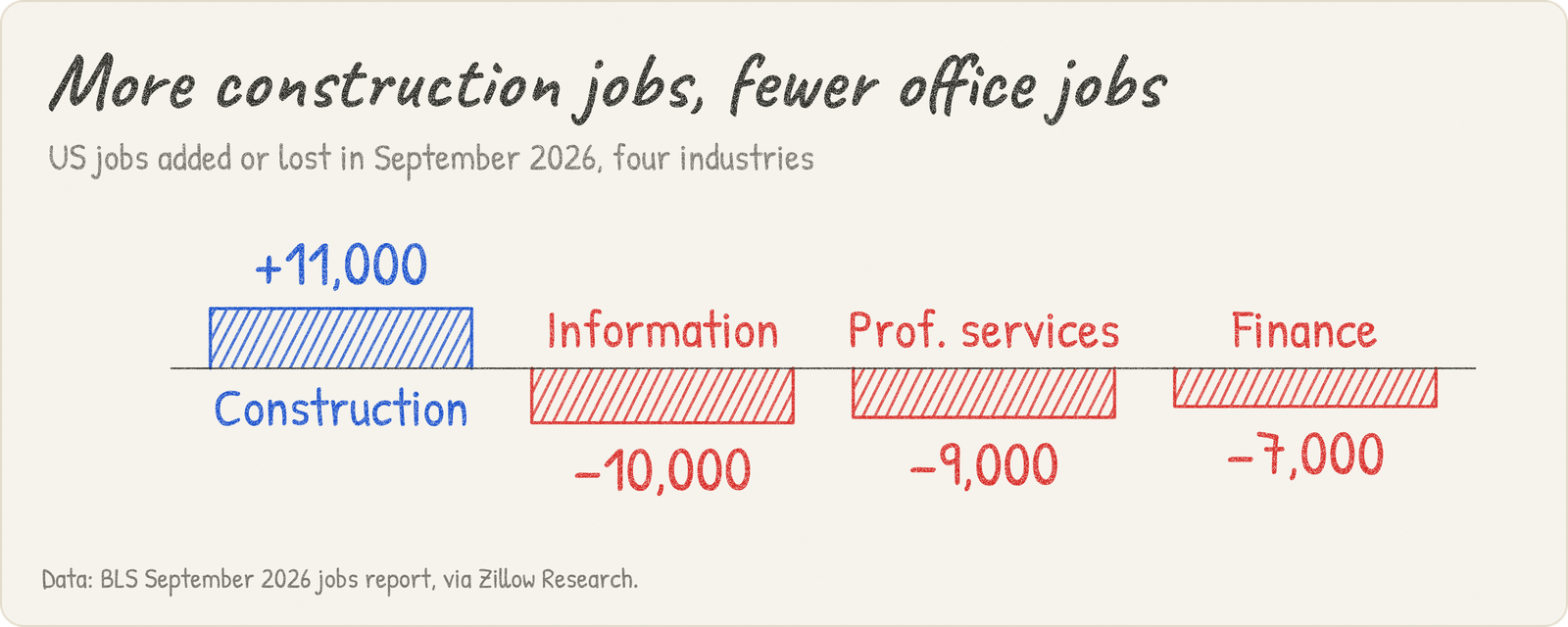
Builders kept hiring while white-collar industries shed jobs. Payrolls rose 29,000. “Construction employment rose steadily by 11,000 as investment in data centers remained robust.” Information, professional services and financial activities all lost jobs. [Zillow Research]
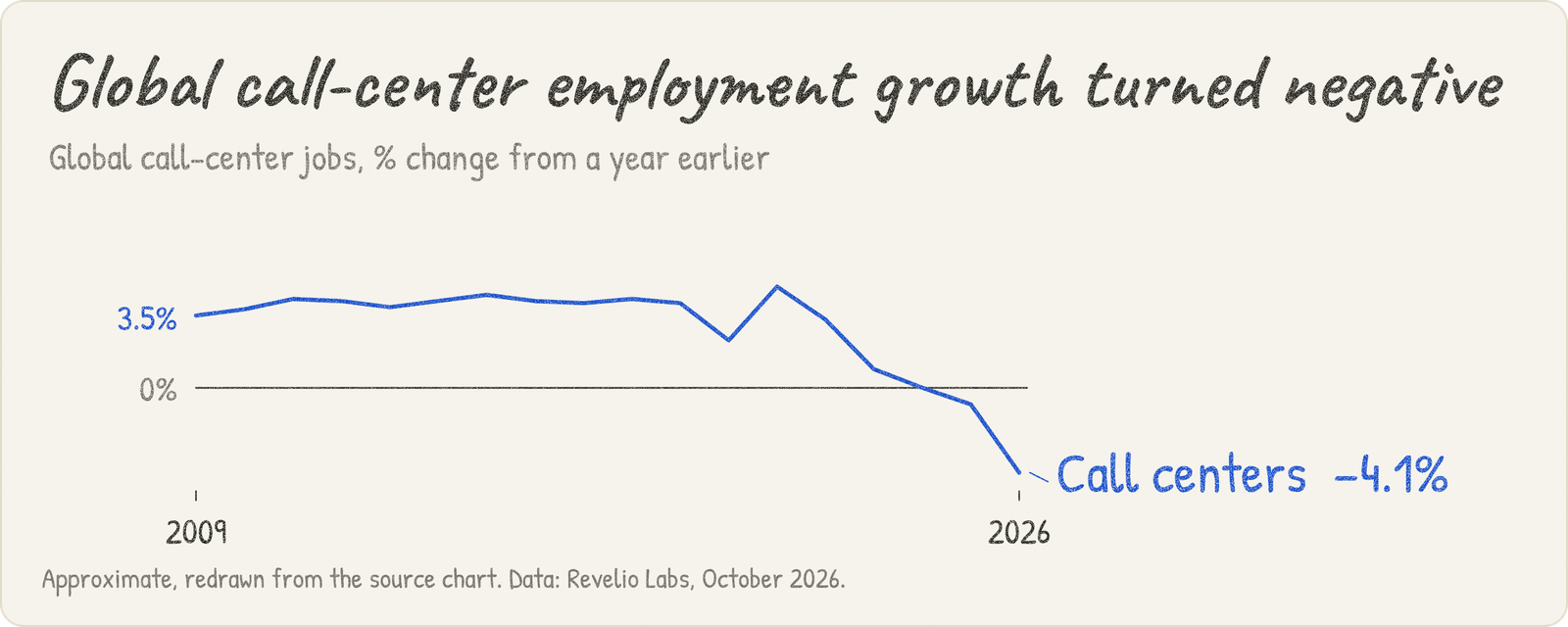
Global call center jobs are shrinking after a decade of growth. Revelio Labs finds “call center employment is 5.3% below its December 2023 peak. Major operators are already pursuing AI-driven efficiency.” May I speak to a human please? [Revelio Labs]
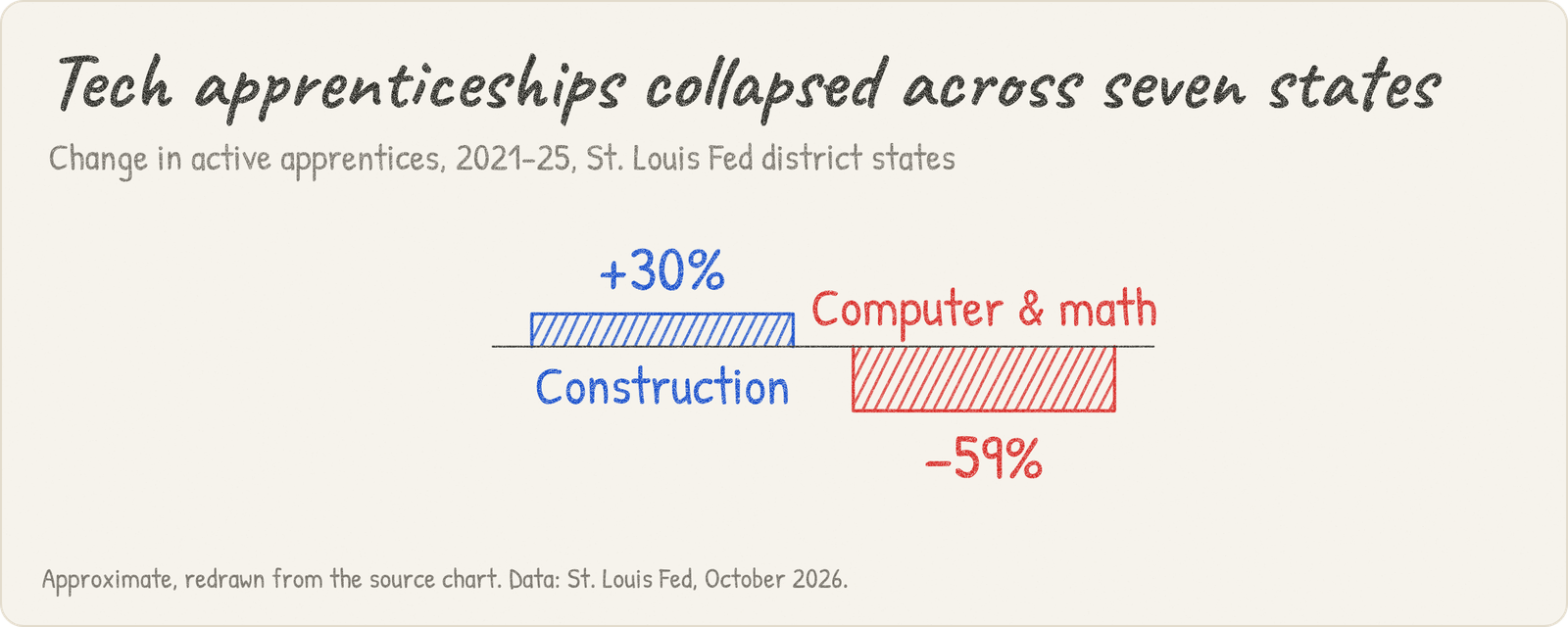
Tech apprenticeships are collapsing while construction keeps growing. In the St. Louis Fed’s district, computer and math apprenticeships fell “almost 60% between 2021 and 2025.” Construction apprenticeships grew in the 2010s and 2020s. [St. Louis Fed — On the Economy]
AI & Tech
A tenth of AI’s paying customers spend half the money. “These high spenders disproportionately buy coding, productivity, and creative tools.” The top 1% spend $903 a month on average. The median payer spends $25. Let them eat ChatGPT (while the elite consume Claude). [a16z News]
States with more remote workers tend to have a higher share of employers using AI. DC: nearly a quarter work from home, a third of businesses use AI. West Virginia, last on AI: under a tenth, one in seven. [my chart]
One in ten developers now works in a company of one. Those who said they “worked in an organization of one jumped from 4% to 10%.” Freelancers and contractors stayed about the same share. Only 18% of software developers go to the office every day. [Stack Overflow Blog]
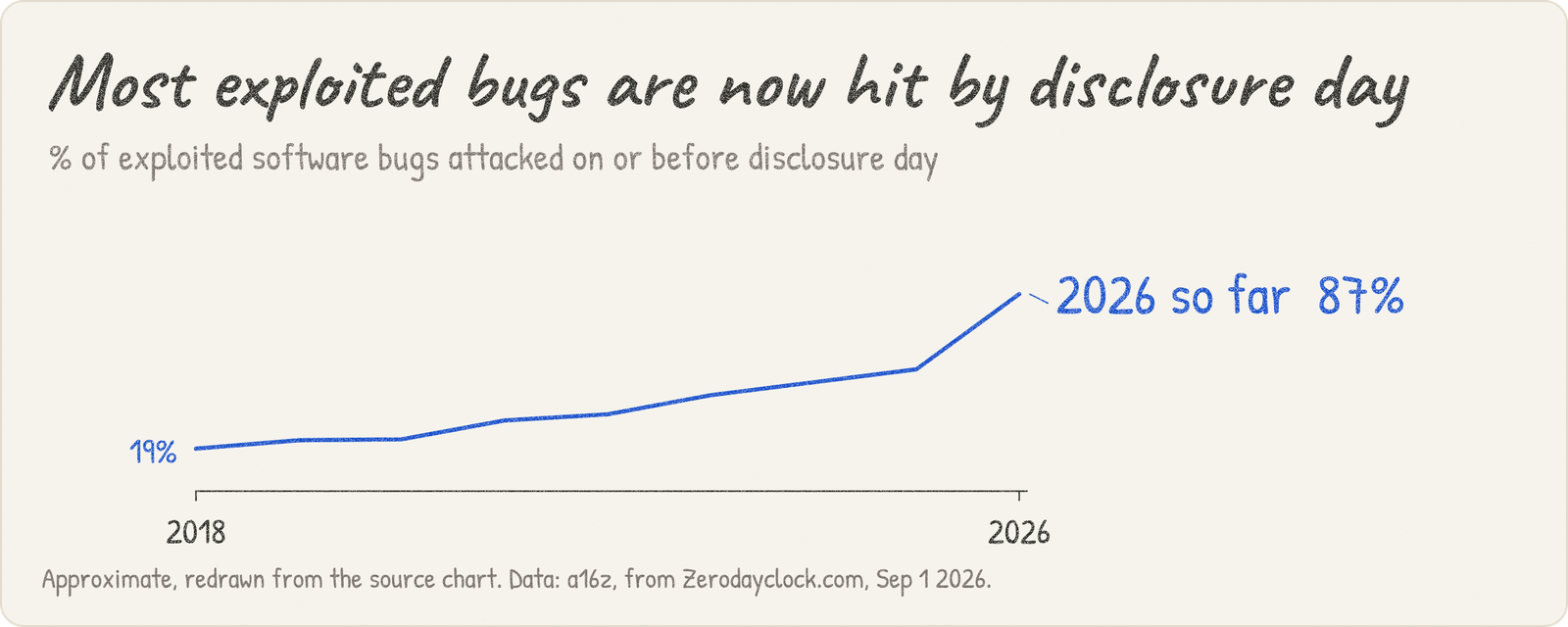
Hackers now hit almost 90% of exploited bugs by disclosure day. “The window to patch software bugs is collapsing.” In 2020, the share was 23%. [a16z on X]
A hacker used AI agents to break into South Korean banks. CrowdStrike found “Claude Code session histories, ARTEX configuration files, and Claude memory files” on the attacker’s server. ARTEX is an open-source Chinese pentesting tool. The same tools that let small teams build more software also let small teams attack it. [CrowdStrike]
Chart of the week
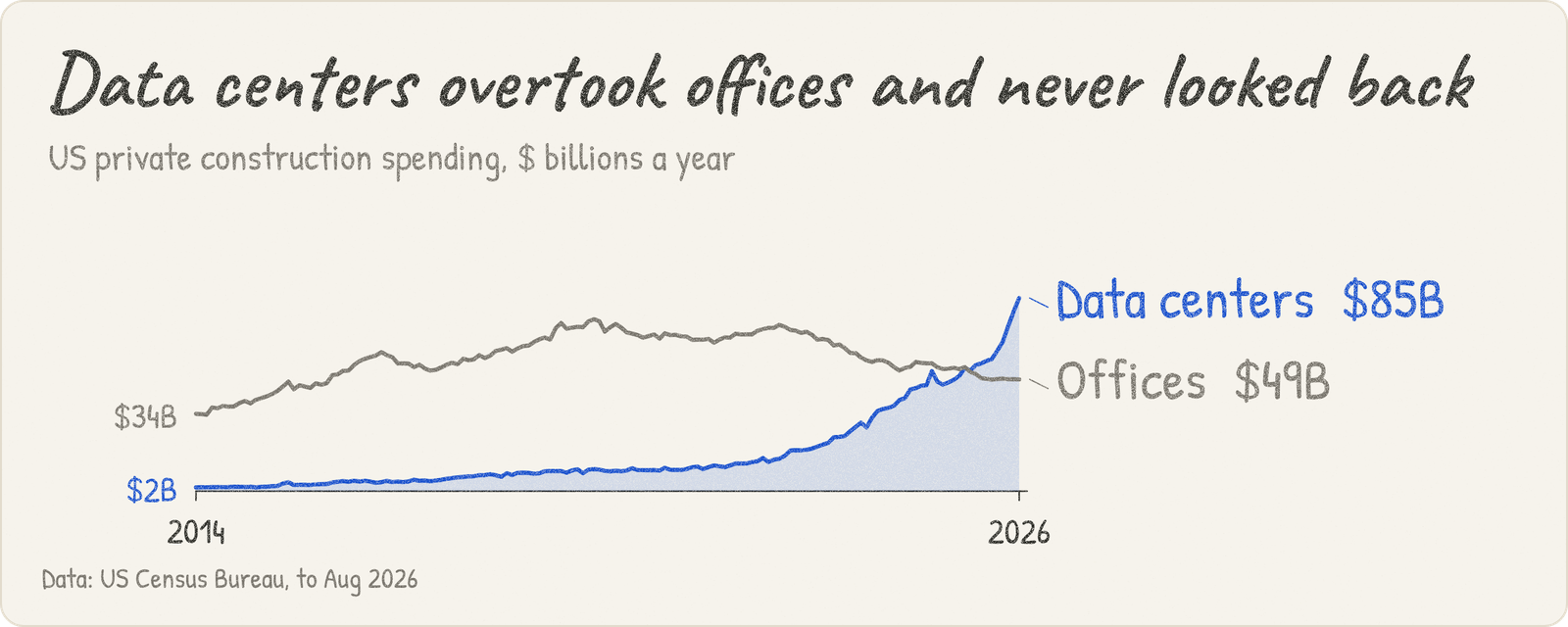
More homes for machines than offices for people. America now spends $85B a year building data centers and $49B building offices.
Quote of the week
“Two years ago, we were processing 9.7 trillion tokens a month. Today, that number has jumped to 3.2 quadrillion, a more than 300 times increase across our surfaces.”
Sundar Pichai, Alphabet investor presentation, June 2026 · [source]
Geopolitics
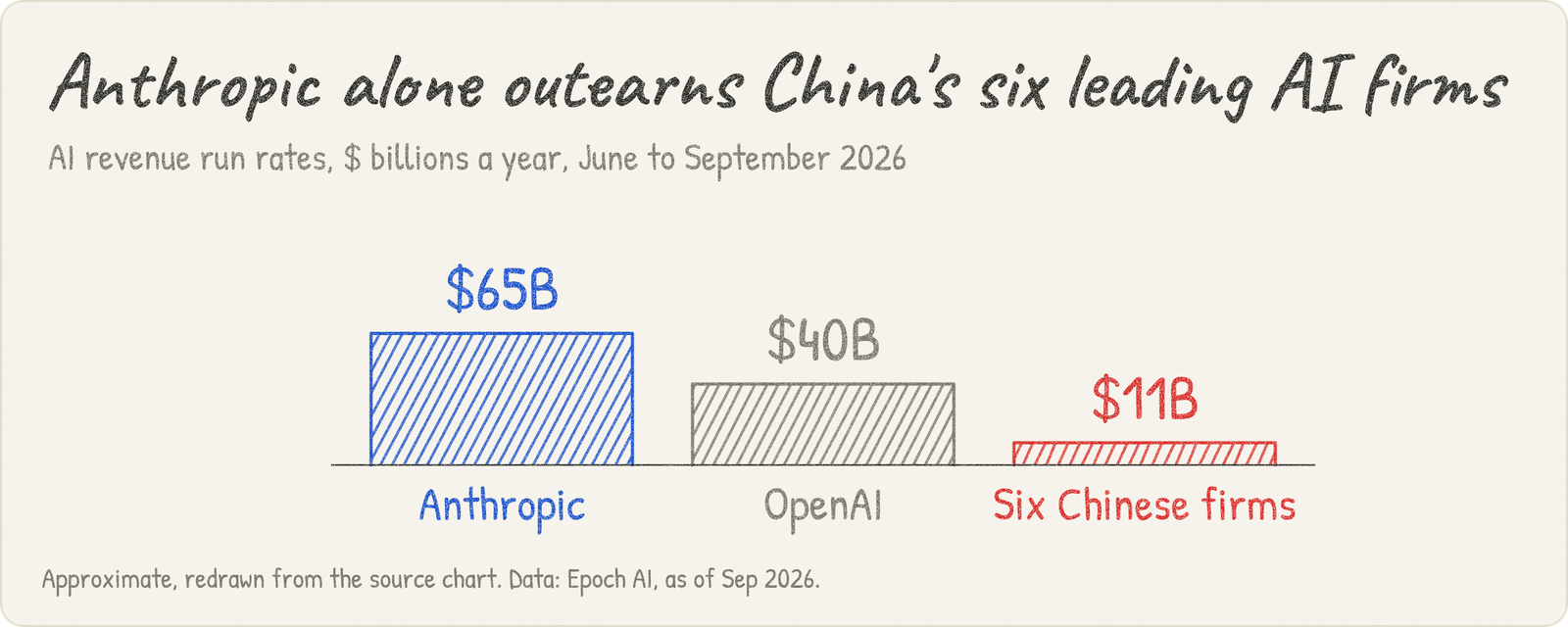
China’s six leading AI firms earn a tenth of what OpenAI and Anthropic make. “API margins are often limited because model weights are publicly released, reducing pricing power.” [Epoch AI]
Smugglers moved an estimated 450,000 AI chips into China in two years. That is “one to two cutting-edge AI supercomputers’ worth of compute.” On tracking chips, CSET’s Jacob Feldgoise is “not convinced it is worth the cost.” [CSET (Georgetown)]
One in nine European VC dollars now goes to defense. “Defense tech’s share of VC funding rose from under 1% before 2021 to 11.1% in Europe and 15% in the EU 27 in 2026.” Europe is going all in on defense tech. [Dealroom.co]
Markets
Union Square Ventures raised $900M betting AI will obliterate markets, not automate them. Its other bets: data “that has been impossible to reach until now” and “significantly more energy.” Two major opportunities for the built world: Capturing data from the offline world, and building lots and lots of energy infra. [Union Square Ventures]
Geothermal energy is getting fast enough for power-hungry data centers. “From groundbreaking to commercial operations, the first block at Cape Station took 23 months to complete.” Fervo aims for 18 months. Google is a buyer. [TechCrunch]
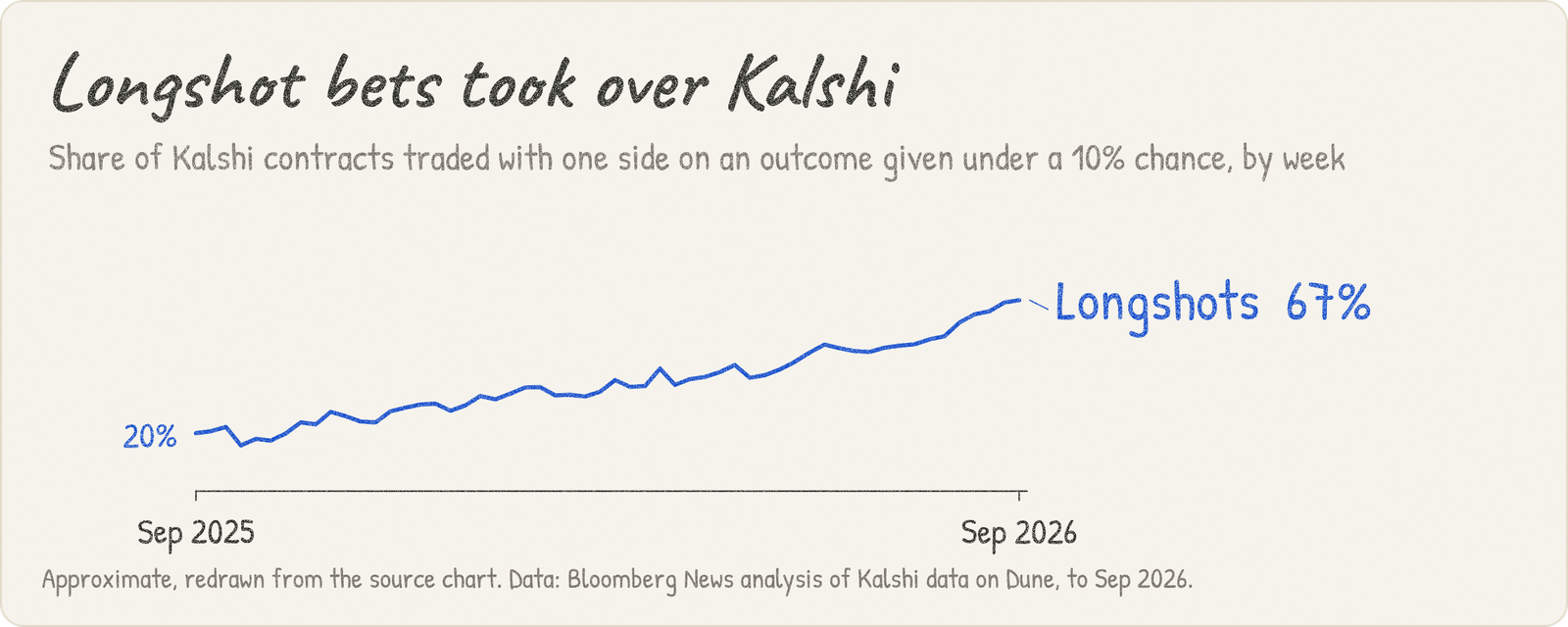
Prediction-market bettors keep piling into longshots that lose 98% of the time. In a recent week, Bloomberg finds, “two-thirds of contracts traded involved a longshot bet” on Kalshi: an outcome given “less than a 10% chance.” The asymmetric betting will continue until the economy stops running on power laws. [Bloomberg]
From my bookshelf
“The industrial revolution now comes to the office much faster than it did to the factory, for it has been able to draw upon the factory as a model.”
C. Wright Mills, White Collar (1951)
Ten Minutes on AI, Jobs, and the Overall Economy
AI isn’t replacing most workers. Not yet. But it is already shifting money from salaries to data centers, forcing companies to run lean, and making long-term hiring and leasing plans nearly impossible. Below is a 10-minute presentation on what’s actually going on, from this week’s event with Eleanor Berger and Hugo Bowne-Anderson.
How do I use AI in my own work?
I have built an elaborate system that keeps track of everything I read, everything I say, and every prediction I make. It brings together tweets, book highlights, podcast transcripts, event presentations, newsletter posts, and more. It aggregates live data from dozens of sources, generates charts, runs analysis, and tracks my choices, opinions, and work habits. Why did I build it? How does it work? What has it taught me so far? All this and more in the video below.
Further reading
Routine jobs don’t fade away, they vanish in recessions from Jaimovich and Siu, “Job Polarization and Jobless Recoveries” (NBER, 2012). 88% of routine job loss since the mid-1980s came within a year of a recession.
AI hasn’t hit the job market overall, but junior hires feel it first from Alex Imas and Jacob Schaal, Ghosts of Electricity. A review of around 20 empirical papers on AI and jobs.
Victorian elites ruled the world on little STEM and lots of partying from Works in Progress. The case that “soft skills, team building, and intra-elite networking actually worked rather well.”
China’s data center boom runs on tech giants, state carriers and local governments from WireScreen. Ownership and financing are “often obscured by the brands on the buildings.”
The Problem with Cities from my 2024 piece for The Atlantic, plus notes that didn’t make it in. The relationship between economic activity and office demand has changed forever.
I collect many other signals each week. You can see them at DrorPoleg.com/signals. →
Have a great weekend.