

Software was supposed to eat the world. Now, the world is eating software. But digesting it might still break the world up.
People say we live in the “Information Age”. Indeed, our economy is increasingly anchored in the production of what economists call information goods: software, content, formulas, and other forms of intellectual property.
There are many differences between information goods and traditional physical goods. In Information Rules (1998), Hal Varian and Carl Shapiro point out one of the most important differences:
“Information is costly to produce, but cheap to reproduce.”
We understand this intuitively. To sell a billion cars, you need to actually produce a billion cars. But to sell a billion movie tickets, you only need to produce one movie. The same is true for software and other information-rich goods.
Software runs on physical infrastructure such as servers and communication networks. But the cost of setting up this infrastructure follows the same logic: a high upfront cost followed by a low cost of serving any additional customer.
To grow, a software business does not need to produce more physical things. By implication, it is not constrained by physical time and space and can grow at virtually unlimited speed to a virtually unlimited scale.
This has been largely true during the Internet and software boom of the past three decades. But the economics of AI seem different. For one, they require larger data centers filled with more expensive equipment and consuming more energy per square foot.
More importantly, the latest AI models consume significant additional resources to serve each additional customer query. When you ask ChatGPT 5.5 or Claude 4.7 a question, they do not simply deliver a cheap, pre-programmed answer. Instead, they reason; they send a series of back-and-forth queries in the background until they figure out what to tell you. From the user’s perspective, it might still feel like traditional software: you type in some input and get back some output. But from the machine’s side, the process is more elaborate, less predictable, and consumes much more energy and computing resources.
AI is not just information being copied. It is information being produced, again and again, every time someone asks a question.
As a result of the above, we are seeing something we’ve never seen before: Software demand is beginning to bump into physical constraints. The world is struggling to allocate sufficient land to build data centers and to produce and redirect the energy required to meet AI demand. Tech giants like Google, Amazon, Meta, and Microsoft are spending an unprecedented amount of money to build these new data centers, but they are approaching their financial limits. Google has recently partnered with Blackstone, one of the world’s largest landlords, to expand and expedite the construction of new data centers.
All this sounds like great news for real estate developers. Finally, order has been restored in the universe: If you want to grow your business, you need to pay more rent; the natural scarcity of land is asserting itself. Instead of software eating the world, it is now the world that is eating the free cash flow generated by software companies.
Not so fast.
It is easy to conclude that Silicon Valley will simply accept these constraints on its growth and profitability. But this is not going to happen. This is not what is already happening.
If buildings and energy on Earth are scarce, entrepreneurs will tap into them elsewhere. In recent months, multiple companies have begun allocating significant resources to developing data centers in space. SpaceX, Google, Nvidia, and Amazon are all in this game. Space has 24/7 sunshine, free air conditioning, no zoning laws or concerned neighbors, and lots and lots of empty space. Closer to earth, startups like Panthalassa are developing data centers that float in the ocean, seeking to capture similar benefits.
It will take some time for innovations of this kind to materialize. But they will. In the short and medium term, AI’s insatiable demand for land and energy is good for those who have a monopoly on these resources on earth. But in the longer term, this demand will fuel innovations that redefine our basic assumptions about the scarcity of land and energy.
In the past, humanity expanded to new continents because people wanted more sugar. In the future, humanity may expand beyond Earth because people want more slop. The joke is that slop may turn out to be more useful than sugar: the same machines that fill the internet with junk may also help us discover new energy, new materials, and new ways to loosen the oldest constraints on human ambition.
Have a great day.
Best,

P.S.
🗞️ I spoke to Fortune about how AI is and isn’t affecting the labor market.
🎧 I chatted with Jacob Shapiro about the nonlinear economy, careers, cities, China, Israel, and more. You can find the full conversation on Spotify, Apple Podcasts, YouTube, and other platforms.
📚 Check out Geoffrey Cain’s excellent new Steve Jobs in Exile (affiliate link), about Apple’s founders' years at NeXT, which shaped his thinking about the internet, software, managing unmanageable people, and managing himself.
How will AI reshape our cities, companies, and careers?
My speaking schedule for the year is filling up. Visit my speaker profile and get in touch to learn more.
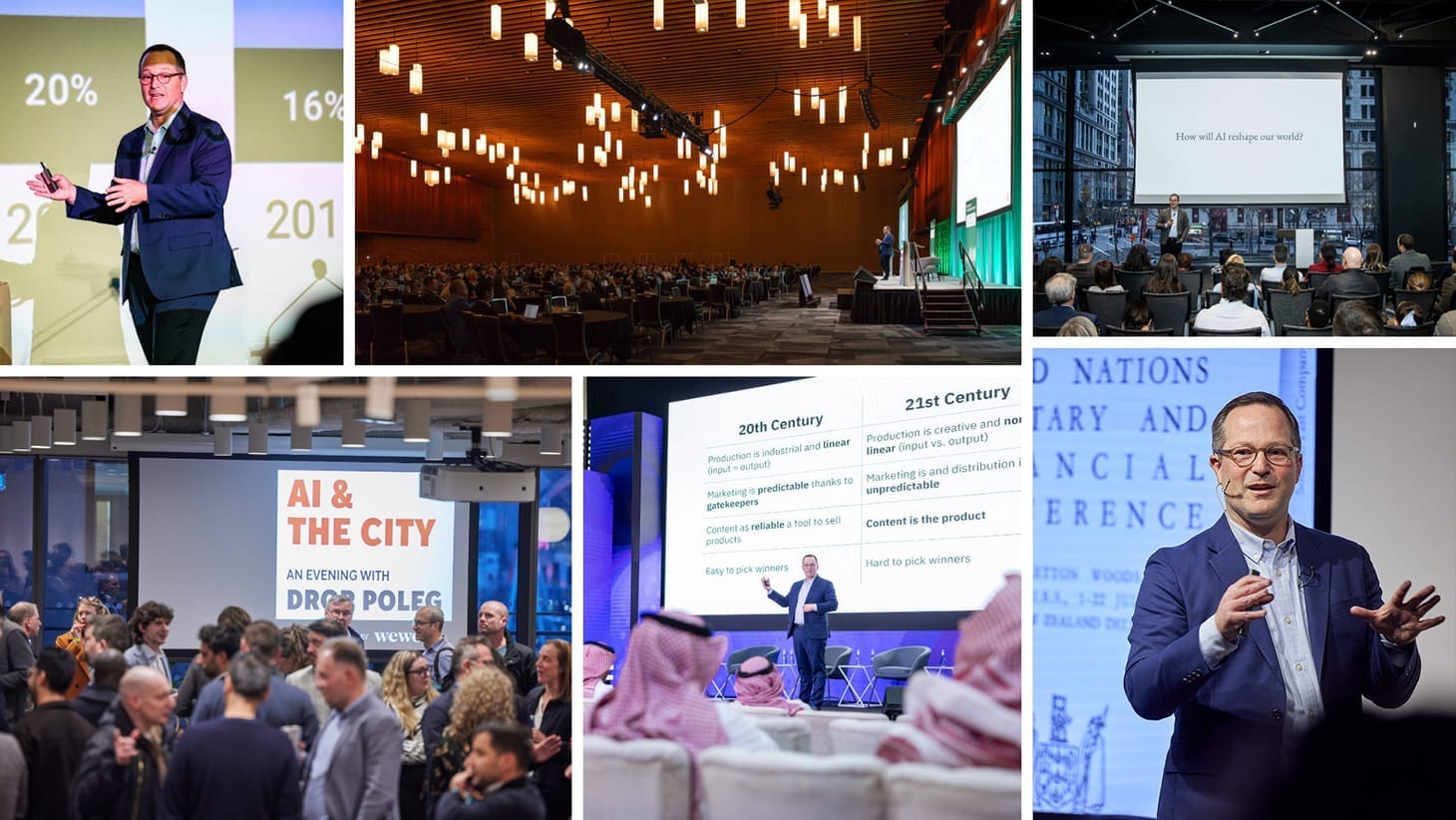
Click here to book a keynote or learn more.
China's total installed power capacity is approximately \(3.99\) TW. Driven by massive state-backed rollouts, China captured a world-leading pace of renewable energy expansion. It is projected to have \(400\) GW of spare power capacity by 2030, which is triple the projected global data center demand.
The US electric grid requires significant infrastructure upgrades, with some regional utilities forced to reject gigawatt-level interconnection requests. US power demand for AI data centers is expected to skyrocket from \(4\) GW in 2024 to well over \(80\) GW (some estimates say \(123\) GW) by 2030.
We need in this country the equivalent of the Manhattan Project to upgrade our electrical grid to compete with China by 2030 but unless we deregulate the expansion of the electrical grid we will cede demand for AI to China imo